

Previously:
Andrea spent the summer in Spain while Carol waited for the relationship, access, and future his name promised. His return ended in a hospital stay instead of the reunion she expected. Now she intends to put the story back in order.
New to the Serial? Start Here | Need the previous chapter? Chapter 1: Work of Fiction
Andrea
Much unhappiness has come into the world
because of bewilderment and things left unsaid.
~Fyodor Dostoevsky
Andrea kissed the inside of her thigh. The heat of her skin didn’t reach him. He remembered where to linger, how much pressure it took to make her gasp. Sex with her had once been kinetic, intoxicating, a bright blur that made thought feel unnecessary. Now, he simply waited for it.
Her thighs tightened around his head. She said nothing. Her hips rolled upward, demanding more. She curled her fingers into his hair. He followed her rhythm without meeting it. She came. Loud. Breathy. Triumphant. She pushed her hips toward him in that final, familiar arch.
Even then, she moaned his middle name. Andrea. Not his first name, the one he actually preferred. The name stayed with him for a second. Then he hoped she would fall back onto the divan, satisfied. He could give her the gifts first, one last finished gesture, before anything uglier had to be named.
No such luck. Her hand moved with purpose, traced his stomach, slipped beneath the loose waistband of his linen pants. His body answered without asking him. He was hard. Of course he was. His health was unreliable, not absent.
He looked down at her flushed skin, her heavy-lidded eyes, her shallow breath. Her body was open to him, willing, impossible to mistake. He moved with what she offered him, steady and unsentimental. Nothing in him reached back. Just the pressure, steady and direct.
She gasped. He could no longer retreat within the motion. Whatever had once been theirs was gone now. Andrea closed his eyes, and let his body find its rhythm. Nothing in the motion belonged to him. Desire had become a borrowed function.
His body remained focused, need severed from longing. Carol clung to his shoulders, moaned his name, and tried to reassert her pace. When he came, the strength of the shudder surprised him, because the release changed nothing.
He pulled out. Rolled onto his back. She curled up to him. But his body had forgotten how to want her. He closed his eyes, not because he was tired, but to disappear. The ceiling fan spun above them.
Carol traced a slow circle over his chest. “You said you brought me presents.”
Andrea opened his eyes. Peace was over. The ceiling fan continued its dull rotation, stirring warm air that smelled of chlorine, sweat, and the jasmine climbing outside the pool house. His pulse had settled, though his body still felt separate from him. Heavy in some places and hollow in others.
“Yes.”
“How many?” The question came too quickly for him to pretend she did not care.
He shifted out from beneath her. The movement sent a small current of dizziness through him, gone before it could settle. He sat at the edge of the divan and reached for his trousers. “Several.”
She pushed herself up onto one elbow. Her beautiful green eyes glimmered, so vibrant and alive. He had spent so long trying to borrow some of that brightness.
“Several?” Her voice brightened.
He stepped into the loose linen pants and tied them at his waist. Behind him, the sheet whispered as she sat up.
“You made it sound like there was one,” she pouted in that way he had once found so adorable.
He suppressed a sigh. “I said I had presents.”
“You said it like someone announcing bad news.”
Andrea glanced at her. “Would you prefer bad news?”
“Not before the presents.” She smiled, pleased with the answer she had made for him.
Two large shopping bags stood inside the teak cabinet. Andrea had placed them there himself that afternoon. He had checked the tissue paper, the ribbons, each receipt folded into its envelope. He had removed the prices because she liked to ask but hated being told.
Carol smiled widely at the bags when he lifted them. Her mouth opened. “Oh, my God.”
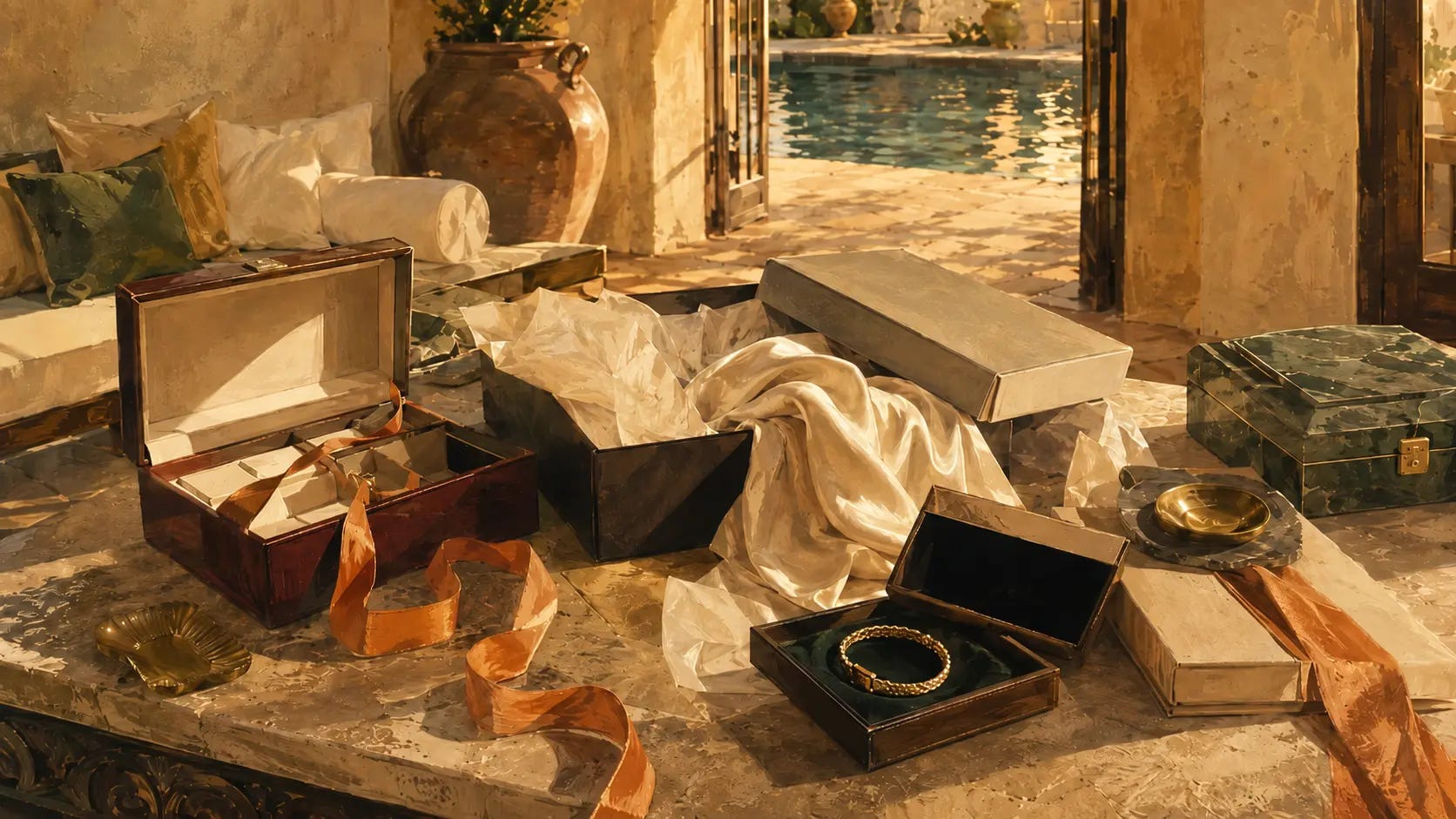
He carried everything to the low table. Burgundy leather boxes, cream paper with gold lettering, and an orange box tied with brown ribbon. Beneath them waited the pale gray Dior box, larger than the others. He had seen the same display spread across the bed in Mallorca while packing, arranged like proof of something already finished.
Carol drew the sheet around herself and slipped from the divan. “You were hiding all of that?”
“I wasn’t hiding it.”
“You absolutely were,” she teased before she knelt beside the table. Her earlier disappointment disappeared so completely that Andrea understood how quickly he had learned to ignore it.
“Which one first?”
“It does not matter.”
“It matters to me.”
He had not meant to sound rude, so he lowered himself into the chair across from her. His legs felt heavier than they should have. Perhaps he had stayed in the sun too long; the flight, the hospital, the medication. There was always an explanation available if he wanted one.
Carol reached for the smallest Cartier box, then paused. “No. You choose.”
Andrea looked at the packages. “The Hermès.”
She drew the orange box toward her. “I knew it.”
“You knew what?”
“That you love me.” Her smile was sweet as she looked at him from beneath her lashes.
Andrea rested one ankle over the other. “You will love your gifts.”
Carol loosened the ribbon without cutting it. She never destroyed expensive packaging. Even empty boxes held status when displayed correctly.
The lid came free. White tissue covered the scarf beneath it. Her hands slowed. Andrea remembered the first hint. They had been leaving a restaurant in Del Mar when a woman passed them wearing silk knotted over her hair. Carol had watched her cross the pavement and said the blue was almost right, though the pattern was too busy.
Two weeks later, she had stopped before an Hermès window and mentioned that true red made cheap silk look cruel. After that came a magazine left open on his kitchen table. He had understood.
Carol folded back the tissue and lifted the scarf. The silk opened in her hands, ivory at the center with a border of deep blue and restrained strokes of red. Not too bright, detailed without becoming crowded.
For several seconds, she said nothing. Then she looked at him. “You remembered.”
He nodded, his smile soft, feeling like the same nail struck by every want she had.
“The blue. And the red isn’t vulgar.” She stood and crossed to the mirror beside the cabinet. The sheet loosened at her shoulder as she draped the scarf around her neck. She adjusted it once, then again, bringing the blue closer to her face. “This is the perfect one.”
“Yes.”
He could tell she was not merely pleased, but vindicated. Some offense had been corrected without his knowing the charge. Her reflection smiled at him as if she were back in control.
She returned to the table and bent to kiss him. Her lips touched his briefly, careful not to smudge her lipstick. “See, you do love me.”
Andrea looked toward the open doors. Beyond the patio, the pool held the last light of evening. Gold moved across the water in narrow pieces. He could hear voices from the main house. One of his sisters laughed, a door closed, and silverware was set somewhere far beyond them.
Carol sat on the rug and reached for Cartier. “This one now?”
“If you like.”
“I do like.” She lifted the burgundy lid. Inside rested a gold bracelet, narrow and clean, with three interlocking bands. Carol stared at it before touching it.
Andrea had bought it in Madrid after she mentioned, more than once, that a woman should not have to choose between yellow, white, and rose gold. The remark had sounded casual. Most of her instructions did.
“Andrea.” She lifted the bracelet from the velvet and turned it beneath the light. “You found it.”
His shoulders tightened at the name. “Yes.”
“They didn’t have my size in San Diego.” She slipped it over her wrist. The bands settled against one another with a soft metallic sound.
“I was not in San Diego.”
“It fits.” Her eyes widened. “You know my wrist measurement?”
“You asked me to fasten enough bracelets.”
Carol laughed and held her arm out, admiring the gold against her skin. “No man remembers things like that.”
Andrea watched the three bands shift as she moved. He had remembered the size because precision prevented inconvenience. A bracelet too large would disappoint her. One too small would become an accusation against her body. It had seemed easier to be exact.
Carol leaned toward him. “Say something.”
“It suits you.”
“That’s all?”
“What would you like me to say?” He watched her study him for a moment, then she smiled again, as if choosing not to notice the question.
“That you imagined it on me.”
The words required little of him. He was tired enough to give her the shape of what she wanted. “I imagined it on you.”
Her expression softened. The distance inside him widened. Carol kissed his cheek this time and reached for the second Cartier box.
“There’s more?”
“Yes.”
The second Cartier box held small gold knots set with diamonds. She had hinted at them months ago, casually enough to deny it. These did not try too hard. She pressed one to each ear and turned her head.
“Perfect.”
Andrea looked at them. “They are.”
She rose again to inspect herself in the mirror. The scarf framed her shoulders. Gold rested at her wrist. Diamonds caught the light when she moved. He knew each piece belonged exactly where she had imagined it. Carol looked more alive with every addition.
Andrea felt himself retreat with each success.
The gifts had seemed thoughtful in Europe. He had visited the shops, spoken with clerks himself, and compared shades under natural light. When the correct size was unavailable, he arranged for it to be brought from another city. Nothing in the process had required longing. Only memory and money.
Carol returned to the table. “The Dior.”
“Open the other one first.”
Her eyes moved to a long cream box. “What is that?”
She pulled the box toward her and lifted the lid. A pair of sunglasses rested inside, dark tortoiseshell with softened square frames. Carol made a sound halfway between a laugh and a gasp.
“No.”
The smell of his mother’s paella reached the pool house. He was tired and hungry.
“Andrea.”
He allowed a faint smile. “They suit you.”
Carol placed the glasses on top of her head, then touched the Dior box. “This one is big.”
He said nothing.
Her smile spread. She pulled the ribbon loose and lifted the lid. Layers of tissue filled the box. Carol moved through them carefully at first, then faster when she glimpsed the leather beneath.
The handbag was structured and cream-colored, with dark red trim and a small gold clasp. The shape was elegant without looking delicate. Large enough to be useful, small enough to require restraint. Carol lifted it with both hands.
She had rolled her eyes at a woman holding the bag and said, “Cream, not white.”
Carol ran her hands over the leather. Her eyes shone as she looked at him. “You got the cream. With the red trim.”
“Yes.”
She held the bag against her body and crossed to the mirror again. She laughed, a bright, breathless sound.
Every package had brought her closer to the version of the evening she expected from him. The reunion, the sex, the proof of devotion laid out in silk and leather. Andrea could almost see the script fixed behind her eyes.
In that story, a summer apart had not changed them. The gifts explained everything. His silence had been illness, and his distance had been his grandfather’s demands.
She turned toward him. “You missed me.”
Andrea looked at the open boxes surrounding her. Tissue paper covered the rug. Ribbons curled along the table. The room had taken on the faint smells of new leather, perfume, and warmed silk. “I thought of you.”
Carol’s smile faltered only slightly. “That’s what I said.”
She crossed the room and settled onto his lap, the Dior bag still looped over one arm. Her weight pressed against the soreness in his thighs. He placed a hand at her waist to steady her.
“You were probably miserable without me.”
“I was very busy.”
“You know what I mean.” Her fingers touched his hair. The shorter length still seemed to confuse her. She arranged the front, trying to restore something that was no longer there. “These prove it.”
Andrea’s gaze moved toward the gifts.
“Prove what?”
“That you know me.” Carol said it with such certainty that he felt an unexpected ache beneath his breastbone. He did know her.
He knew her wrist measurement and that she preferred gold. The difference between cream and white, and which red she considered elegant and which one offended her. Diamonds small enough to suggest restraint and expensive enough to defeat it. The shape of sunglasses she believed softened her face. The knowledge sat before them in perfect boxes.
None of it brought him closer to her.
Carol kissed him, slower this time. Her mouth was warm and familiar, the pressure practiced. When she pulled away, satisfaction had settled over her face. “You got everything right.”
“Yes.” The word barely carried.
Carol rested her forehead against his. “You always do.”
A quiet recognition moved through him. Perhaps that had been the problem. He had learned her preferences so thoroughly that every small disappointment arrived already managed. She called it love because the results pleased her.
Andrea had called it love because that was the name his parents had given the performance. He moved his hand from her waist. Fatigue had settled into his bones, threaded with hunger and dizziness. He would regret entering the house, where his mother would suffocate him with attention, but he needed to be done. “I’m sorry. I’m not feeling well.”
“Oh, let me get dressed,” she said, jumping off to pull her clothes on.
The gifts had worked. Otherwise, she would have given him the “not again” look.
Author’s note
Dostoevsky wrote that much unhappiness has entered the world through bewilderment and things left unsaid. I chose that line because this chapter examines the damage silence causes before anyone recognizes it for what it is. Confusion gathers around what neither person will name.
The mind dislikes a vacancy and fills it with whatever evidence happens to be available. A remembered preference suggests devotion. Good manners discourage scrutiny, mostly because scrutiny has a nasty habit of ruining dinner.
Competence gives Andrea somewhere respectable to hide. His behavior causes no obvious alarm, so he can postpone examining why his feelings have gone quiet. Everyone sees a considerate man performing the role expected of him. The emotional paperwork remains immaculate.
Carol draws the conclusion she needs from that performance. His memory proves she matters. Each gift confirms the future she already believes they share. Her interpretation contains enough truth to withstand casual inspection, which makes it harder to challenge.
By the chapter’s end, Andrea has given Carol something beautiful and emotionally useless. Courtesy protects the arrangement until honesty requires more courage than either person can manage at that moment.
The story between them keeps growing, fed by everything Andrea cannot bring himself to say.
Which is colder: Andrea giving her everything she wanted, or Carol acting as though the gifts proved he still loved her?


All parts of Beneath the Weight of Water and the first part of Inherited Shame are free for everyone.
Paid subscribers receive early chapter access, bonus scenes, and The Grumpy Writer.
Work arrives by email. No ads. No noise.
Copyright © 2026 Angelica Thorne
For permission requests, contact angelicathorne@icloud.com.