

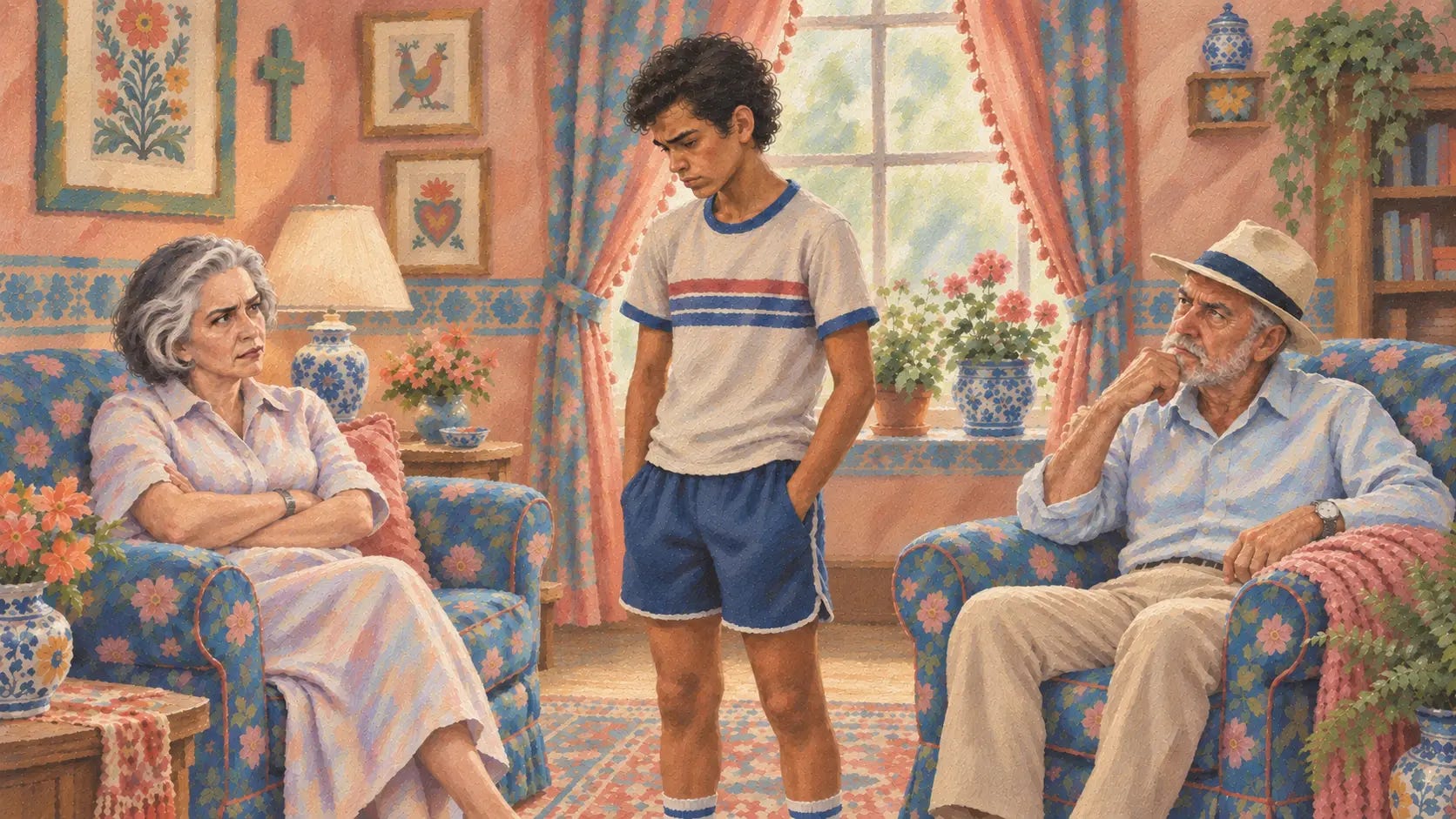
Once Abuela ranks her family’s wounds, her sympathy becomes a ruling on who has suffered more and who can take more pain.
Writing about generational abuse created both a structural and an emotional challenge. Lucia’s Mexican American family couldn’t appear uniformly abusive, and her barrio couldn’t become an ethnic explanation for violence. At the same time, adding enough loving relatives and generous neighbors to offset the abuse would reduce the family to a moral balance sheet.
The same community that guards its own can also guard the silence around an abuser. Abuela can love Lucia while demanding that she absorb Bruno’s rage. Johnny can try to protect his sister and still fail to understand what she needs from him.
My problem was not deciding how many good people could offset Bruno. It was writing protection as part of the machinery that kept him dangerous.
Ranking Wounds
Writing Abuela required me to account for something I’d taken years to understand about my paternal family. They tried to protect me from my father’s violence by pacifying him and diverting his attention. It confused me because I felt they were protecting him too.
When I was older, my grandmother explained that, as a teenager, my father had survived an attempt on his life that left him buried in a mine for hours. His family couldn’t help but remember that traumatized young man and the drastic change in his personality afterward. His alcohol problem and abuse therefore had an established explanation and his family’s longstanding sympathy. My bruises entered a comparison I could never win.
That recognition gave me a way to write Abuela’s reasoning. Bruno’s wound has a history his mother understands.
Once Abuela ranks her family’s wounds, her sympathy becomes a ruling on who has suffered more and who can take more pain. Abuela calls Bruno a good man while Lucia endures his violence. She pressures her granddaughter to give up school and work to help him endure his wound. Each demand follows a logic Abuela can defend, with Lucia supplying whatever that defense requires. By keeping the excuse next to the consequence, I made it clear that Abuela recognizes Lucia’s pain but still gives Bruno’s suffering priority. Lucia, apparently, can afford another installment.
The Discipline of Limited Knowledge
As the writer, I understand the complexity of the hidden family history and the connections Lucia can’t yet make. That knowledge guides how I write her grandmother, but it can’t enter Lucia’s narration before she’s learned it.
The distinction matters at the sentence level. Abuela wails as her son beats Lucia. Her grandmother’s pain can be sincere even as she demands that Lucia endure. Both responses belong in the scene.
Abuela’s conduct has to carry what the narration can’t disclose. Readers have to base their judgment on the evidence available to them. I can’t treat it as a misunderstanding simply because I know more.
To explain Abuela’s history, I’d have to ask Lucia to step aside while I make sure everyone appreciates how complicated her grandmother is. The restraint belongs to me. Lucia can’t become prematurely wise so I can feel satisfied that I’ve written a complex grandmother.
Explanation Cannot Become Acquittal
Bruno’s troubled relationship with his stepfather is part of his wound and informs how I write his resentment. The danger lies in making that connection so tidy that his childhood appears to dictate his adult behavior. A convincing cause can quietly become an excuse if I remove every choice between the injury and the violence. I need to begin with the boy’s wound, but the man is the one currently deciding whose body will answer for his childhood.
In the opening scene, he demands money from Abuela: “You owe me because you married that bastard.” The dialogue lets his history enter through his entitlement. He considers his mother’s marriage a debt she still owes him, with no apparent limit on collections.
Lucia stands nearby, anticipating what his anger will cost her. Keeping the scene in her viewpoint means his grievance reaches readers alongside the fear he creates. His explanation can’t take possession of the narrative simply because he delivers it loudly.
Culture Is Context, Not Cause
Stopping the novel to announce that abuse isn’t specific to this community would turn a scene into a public relations appointment.Writing this barrio requires attention to what its residents mean by family loyalty and who can claim authority. When Abuela tells Lucia she doesn’t understand what life is like for men, gender becomes an argument for endurance. Mexican American culture doesn’t justify the demand, but Abuela’s words reveal how she interprets that culture.
The neighborhood gives me the opportunity to further explore the concept. Mrs. Linda and Mr. Jamar, the Black couple nearby, use their standing to offer Lucia a safe walk home. Doña Cuca welcomes her with affection but also helps enforce expectations about the kind of man she should marry. Those scenes let belonging offer comfort while retaining conditions Lucia has to navigate.
The familiar question “Why didn’t she just leave?” already travels comfortably across cultural boundaries. My task is to write what makes leaving difficult. Removing those particulars would leave Lucia with fewer believable reasons to hesitate and then invite readers to blame her for ambivalence.
Write the Arc Through Access
Lucia’s growth has to become visible in whom she calls, what she keeps private, and what she begins to refuse. She can love someone and still limit their access to her. Writing that change means allowing her to retreat, reconsider, and try again without treating every backward step as the cancellation of her progress.
Whether she ultimately sets boundaries or chooses to leave, neither is easy to accomplish or survive. As abuse survivors, we can heal and control our own lives, and yet some of us negotiate presence even as the scars remain.
Writing Lucia requires that same respect for her journey and what survives a repair.
When has a character’s tragic backstory made you think the author was making excuses?
Thank you for reading!


Subscribe to receive new chapters by email every other Saturday.
All parts of Beneath the Weight of Water and the first part of Inherited Shame are free for everyone.
Paid subscribers receive early chapter access, bonus scenes, and The Grumpy Writer.
Work arrives by email. No ads. No noise.
Copyright © 2026 Angelica Thorne
For permission requests, contact angelicathorne@icloud.com.