

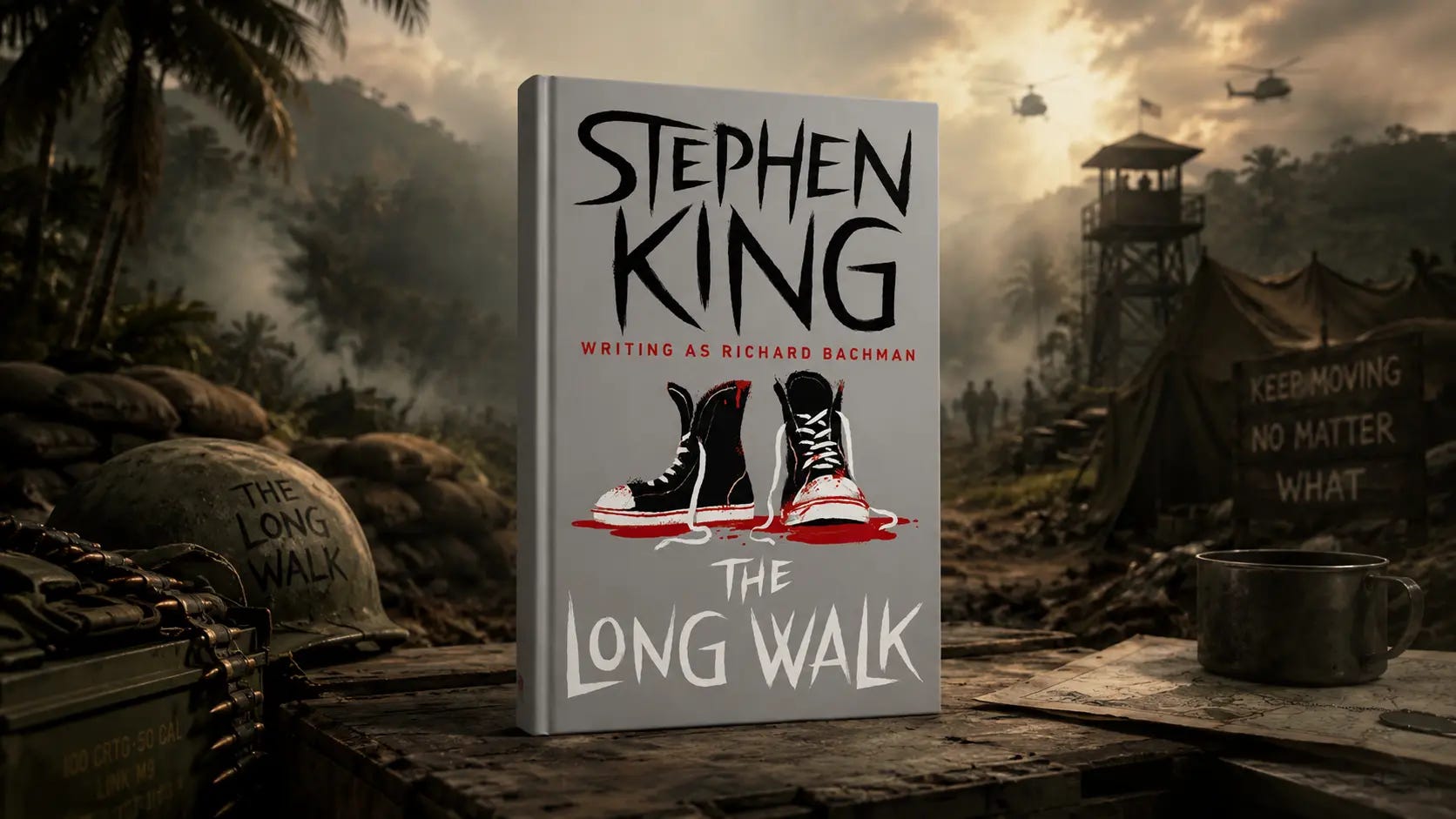
Warning: Spoilers ahead. This review walks the road to the end.
Calling a book enjoyable feels heavy when it leaves you staring at the ceiling with a bitter sadness. I picked up Stephen King’s early work, written under the Bachman pseudonym, expecting a vintage horror puzzle to pass an afternoon. Instead, The Long Walk felt like sitting in a dark room watching grainy footage of an institutional meat grinder. Some books exist to help you escape reality. This one confronts the ugliest parts of our social structures directly.
Publishers have a terrible habit of demanding that literature fit neatly into performance metrics. Books need to have a clean rating, a snappy summary, and a clear moral lesson that resolves before we turn out the lights. King flatly refuses to cooperate with that corporate desire.
He dumps the reader onto hot asphalt in Maine and introduces one hundred teenage boys marching south toward their own executions. The true horror does not come from physical decay. It comes from the sickening realization that society has lined up to cheer for the slaughter.
The Machinery of the Draft
The rules of the road are brutally mechanical. If a boy drops below four miles per hour, a soldier gives him a warning. Three warnings mean you receive your ticket, a sterile bureaucratic euphemism for being shot in the head. This setup constantly dragged my brain back to the late nineteen-sixties and the psychological terror of the Vietnam draft. Those in charge pretended that automation handled the lottery, and every healthy young male faced the same statistical odds.
History shows how these state-sponsored lottery systems operate. Wealthy families find a convenient loophole, a sympathetic doctor discovers a sudden bone spur, or an influential father secures a placement far away from the front lines. Meanwhile, working-class youth get hauled off to the front because they lack the leverage to escape the clipboard.
King captures that selective blindness perfectly. His walkers are ordinary, vulnerable children out of their depth, marching down a road that collects their bodies without checking their names.
Hollow Promises and Elite Hypocrisy
The state buys compliance by dangling a glittering mirage called the Prize. If you survive the Walk, you receive literally anything you want for life. It sounds like the ultimate golden ticket. This specific institutional carrot reminded me instantly of that ridiculous Pepsi commercial from the nineties, where they promised a military jet to anyone who collected enough points. When a kid actually claimed the plane, the company immediately hired a fleet of lawyers to explain that the promise was never real. Just marketing theater. Not false advertisement.
Our government treats young people with that same corporate cynicism. It promised them the GI Bill, an education or a home, and a fair shot at stability if they survived deployment. Then the fine print shows up after the ink has already dried. Historically, local gatekeepers and administrators systematically denied Black and Brown soldiers those life-changing benefits. The prize functions as a brilliant recruiting tool, but the house always hedges its bets when the bill comes due.
This systemic hypocrisy thrives in modern structures. Today, tech billionaires lecture regular parents about how higher education is a rotten scam that ruins young minds. They tell you to send your children straight into trade schools or entry-level labor pipelines. Meanwhile, behind closed doors, those same elites write checks to secure their own children’s legacy admissions into Ivy League universities. They hoard influence and keep the population available for heavy lifting. A fresh generation learns too late that no one properly installed the floor.
Brotherhood and the Burden of Realism
To navigate a rigged board like this, you have to look at how the boys relate under extreme pressure. Stanley Karnow’s Vietnam: A History strips away the Hollywood romanticism of wartime brotherhood. He describes kids from completely different backgrounds thrown into a foxhole together, forced to form temporary alliances for survival. We see that same dynamic unfold on the asphalt strip. The most heartbreaking moment belongs to Barkovitch, a malicious boy whose armor cracks at the end, exposing a terrified child desperate to bond with the peers he insulted because he cannot bear dying alone in the dark.
The only character who truly anchored my brain on that highway was Stebbins. He operates on a separate psychological plane from the panicking walkers, and his realist, analytical mind immediately stands out. No metabolic energy gets wasted on fake-deep bonding or social performance. He knows from the first mile that the house has rigged the game, yet he steps onto the road and takes his chances, anyway. As someone who naturally analyzes systems, I related to his unblinking clarity.
There is a lonely dignity in his strategy. Stebbins tracks the mechanics of the meat grinder with precision, refusing to buy into the false hope that preserves weaker minds for a few more miles. His collapse hits hardest because it proves that intelligence and flawless strategy cannot save you from an institution that wants your life. You can understand the system perfectly, and the system will still grind you down to the bone before casting your body into the weeds.
The Mirage of the Finish Line
The ultimate lie of The Long Walk is the finish line. Ray Garraty wins the game when Stebbins drops dead on the asphalt, but his victory feels like a final act of institutional sadism. When the Major steps forward to hand over the world, Garraty does not recognize him. He is staring at a dark, phantom figure walking ahead of him in the distance, a shadow signaling that the march never actually stops. His body survived the test, but his mind remains permanently trapped on the highway.
This haunting image captures the reality of trauma polite society tries to ignore. People desperately want to believe survival is a simple reset button. We tell ourselves that when conflicts end, the survivor can slot back into normal life without causing a scene. That expectation is a complete delusion.
Trauma does not dissolve because an authority figure declares a conflict over. The state can hand you a medal, a pension, or a blank check, but those gestures cannot purchase the return of the person you were before the machinery chewed on your soul. Ray Garraty does not run toward a bright future at the end of that book. He runs because his mind has lost the capacity to recognize safety, leaving him to chase a ghost down an endless road that never intended to let him go home.
I found this out the hard way. My father abused me throughout childhood, and despite decades of therapy and self-awareness, my brain still functions on a trauma-informed frequency. When a system forces your neurology into a defensive stance for too long, you lose the ability to feel life clearly.
Shelve Test: 4 – Loved
Because some books do not exist to entertain you. They leave you sitting in the quiet, wondering how we convinced ourselves that the machinery was ever going to let us win.
Book Details
Title: The Long Walk
Author: Richard Bachman, aka Stephen King
Published: 1979
Genre: Dystopian horror / psychological horror
Thank you for reading.
What is the worst lie the system sells in The Long Walk: that the boys can win, that the Prize is real, or that survival means freedom?
Start Here: Beneath the Weight of Water | 1980s Fiction Saga

Lucia Perez lives in a house where anger is excused, silence is expected, and survival means staying small. She keeps her head down, studies hard, and holds on to one fragile hope: that education might be her way out.
Thank you for reading. Paid subscriptions are optional support for future chapters, illustrations, and the long work of keeping the story alive.
Copyright © 2026 Angelica Thorne
For permission requests, contact angelicathorne@icloud.com.
I saw the movie a few weeks ago -- I appreciate it even more after your thoughtful analysis. It reminded me of The Hunger Games, which is now more than ever a metaphor for our society.