

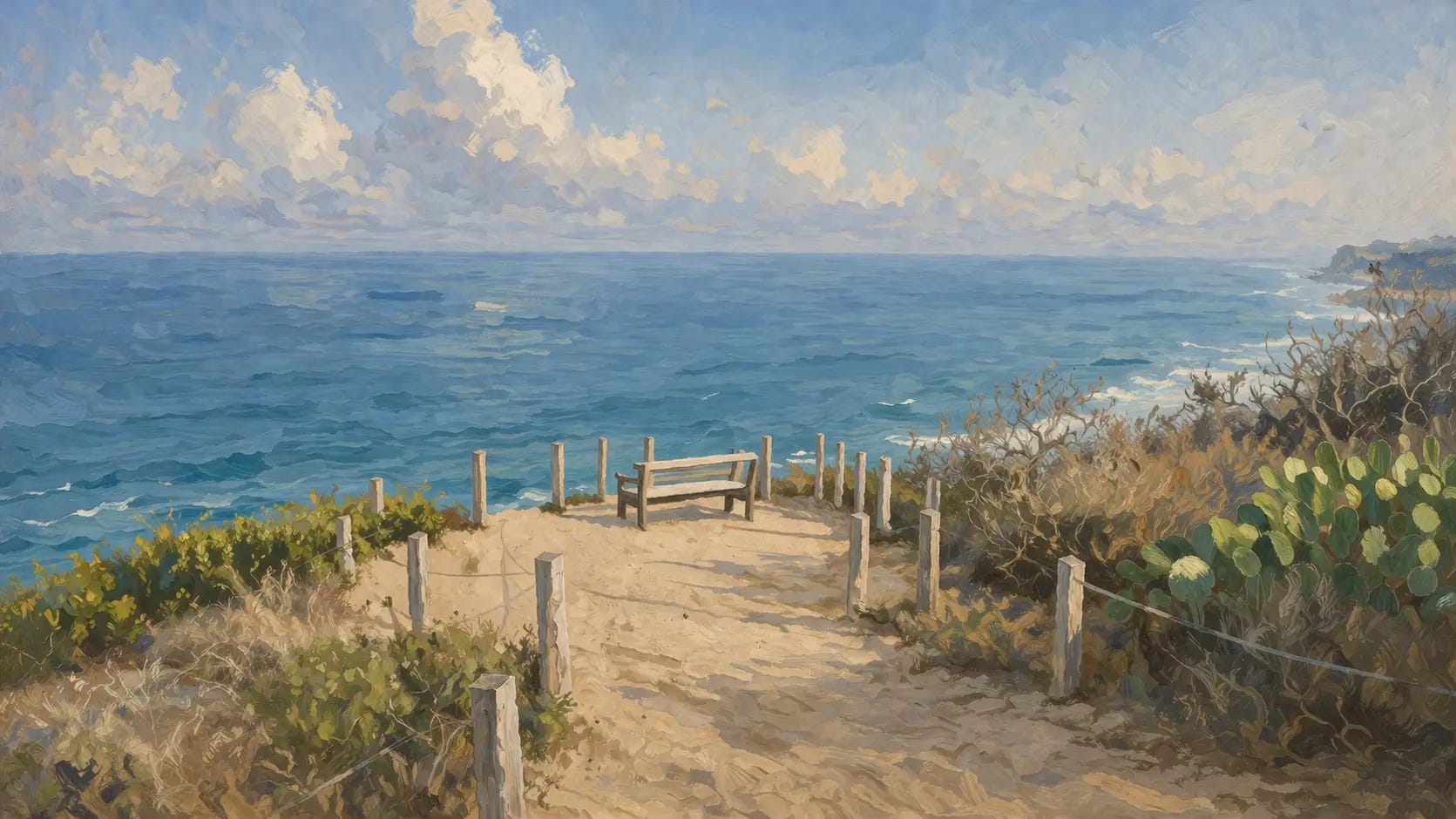
Overlook at The Guy Fleming Trail
I learned to write description sitting on a bench above the Pacific Ocean. Not at a desk, or in a classroom, or a book on craft.
But on a trail I wasn’t supposed to love as much as I did. The Guy Fleming Trail at Torrey Pines State Natural Reserve was the short one. You walked the loop, and if you were lucky, the bench on the overlook was empty.
A bench that faced the horizon without asking anything of you except that you sit still.
I was in my twenties. I carried notebooks everywhere. My handwriting was precise back then, tiny and careful. Legible in a way that feels like I was trying to control something that kept slipping.
I wrote with erasable ink pens that promised neatness and delivered smudges. The pages never stayed clean. My fingers didn’t either. But I kept using them anyway.
Below me, the ocean vibrated, shifting second by second, making it impossible for my ASD mind to be precise. The water didn’t stay one color. Blue if you looked quickly. Silver, depending on the angle of the light. Sometimes green, if I let my eyes go before they lost focus.
The horizon didn’t hold a line, but blurred as it breathed, redrawing itself while I was still trying to describe the last version.
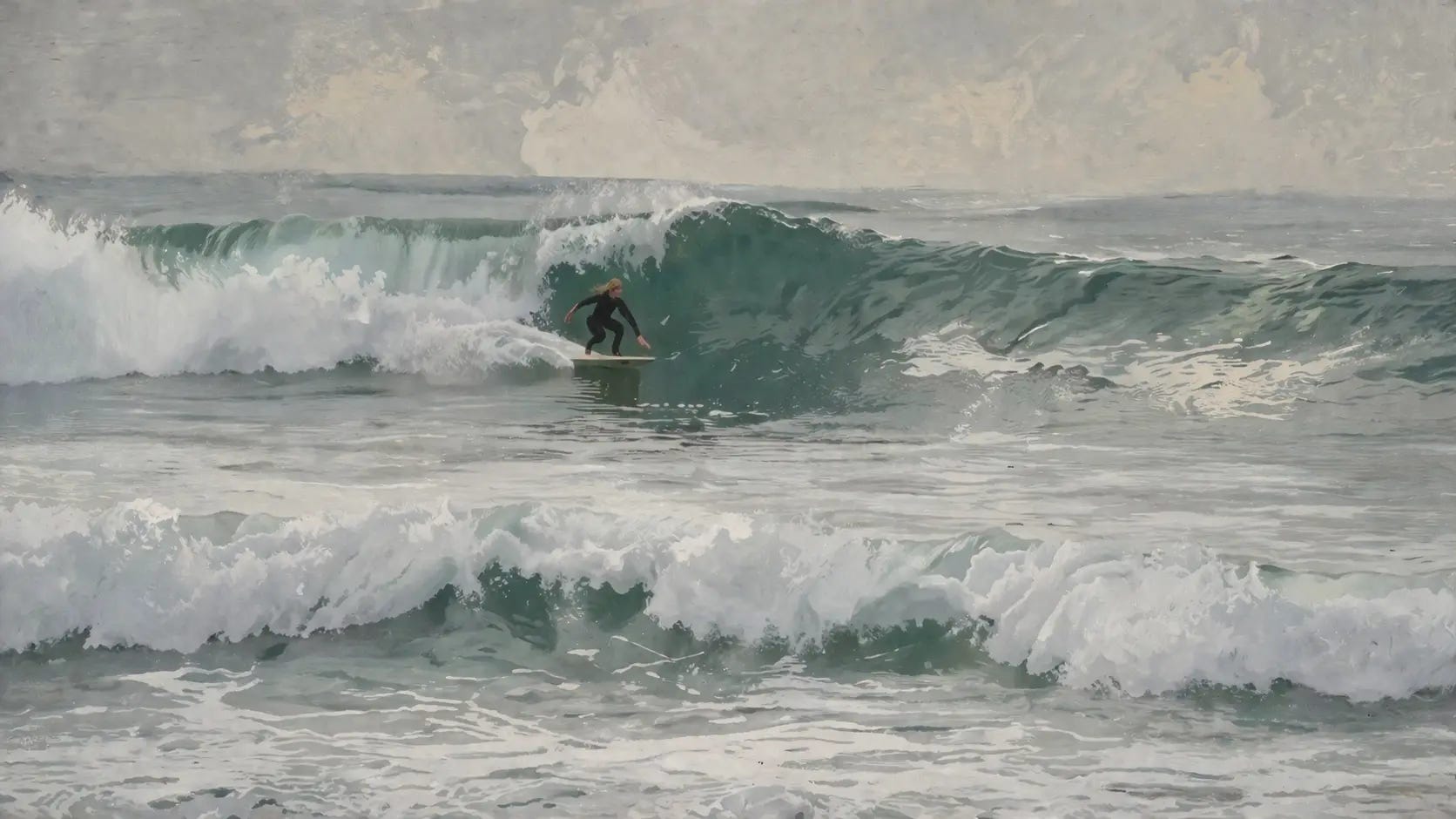
My Blonde Surfer
The Surfer
And somewhere inside all that movement, he was there.
My blonde surfer.
I loved the ocean and always will. But I have never trusted myself to it. So I climbed the trail while he carried his board down to the waves.
He went straight into the Pacific without hesitation, without negotiation, like it had already agreed to hold him up. He understood the ocean, and it accepted him.
I watched him become smaller and larger as the waves lifted him. Again and again, he rose out of the water, balanced, steady, riding something I could barely follow with my eyes. Sometimes he disappeared completely.
I opened my notebook. And I tried to write it. That was the exercise, not assigned or even structured. Just something I couldn’t stop doing.
I wrote about the ways the light hit the water and broke apart. The rich smell of the Torrey pines, sharp and dry, mixing with salt in the ocean breeze. I tried to capture the sound of the waves, which was never just one sound but a sequence. The pull. The crash. The drag back into itself. But I was never satisfied.
And I wrote him.
The way his blonde hair caught the sun. How his body shifted as he adjusted his balance. The way I could recognize him even when he was far enough away to be mistaken for anyone.
Every time I wrote it down, everything changed. Not because the ocean changed, though it did. Not because he changed, though he did too. Because I was learning how to see.
Description was never decoration for me, nor filler to skim past to get to the part where people talk or act or decide.
It was the act of staying.
Staying long enough to notice that the water wasn’t one color, the horizon didn’t behave, that the same wave could look different depending on when you caught it. And that while my blonde surfer loved me, he was impossible to hold onto.
The notebooks filled up. Page after page of attempts to pin something down that didn’t want to stay still.
I wrote the same moment from different angles. Every sentence failed in some small way. Too general, or too neat, and sometimes too quick to settle on a word that almost worked. I crossed things out. I smeared ink across the page, trying to fix something that refused to keep still.
I loved those notebooks. They weren’t drafts of anything. I never meant for them to lead to a story. They were just a record of how I was learning to look at the world without rushing past it.
Some of them are still with me. Some of them are not.
I tell myself I remember what was in them. That might be true. It might also be the kind of thing you say when the object is gone and you need the memory to do more work than it was meant to do.
But I remember the bench. I remember the way the ocean turned to silver when the light shifted. I remember the way my hand cramped from writing too small, too tightly, trying to fit as much as I could into the space I had.
And I remember him.
My blonde surfer.
He did not stay.
That is the part I can say plainly now.
He became ashes.
There is no metaphor in that sentence that improves it. There is no softer version that tells the truth more cleanly. He is gone in a way that does not negotiate with memory or language. Not when he died in my arms.
And still, when I think of the Pacific, I see him in it. As he was, there. Moving through something larger than both of us, something I never entered and he never feared.
No ocean has ever looked the same to me since. Not because other oceans are lesser. Because the Pacific still holds him.

I write differently now. The sentences are tighter. My structure is more deliberate. I know what I am doing in a way I did not then.
But when I sit down to write a description, I am back on that bench. Still trying to get it right, failing in the same small ways. Still adjusting and refusing to let the first version be the one that stands. Because I know what happens when you rush.
You lose the color shift. The smell vanishes. And the way a person looks when they are close enough to recognize and far enough to disappear is lost.
You lose the part that makes the moment worth returning to. And some moments do not give you another chance.
So I stay a little longer. I look again. And I write it down, knowing it will never be enough, but doing it anyway.
Thank you for reading Beneath the Weight of Water. Paid subscriptions are optional support for future chapters, illustrations, and the long work of keeping the story alive.
What is the moment you keep returning to, even when it won’t stay still?
Next Chapter

Previous Chapter

Start from the Beginning
If you like writing essays about craft, revision, and the deeply offensive behavior of first drafts, subscribe for more.
Copyright © 2026 Angelica Thorne
For permission requests, contact angelicathorne@icloud.com.