

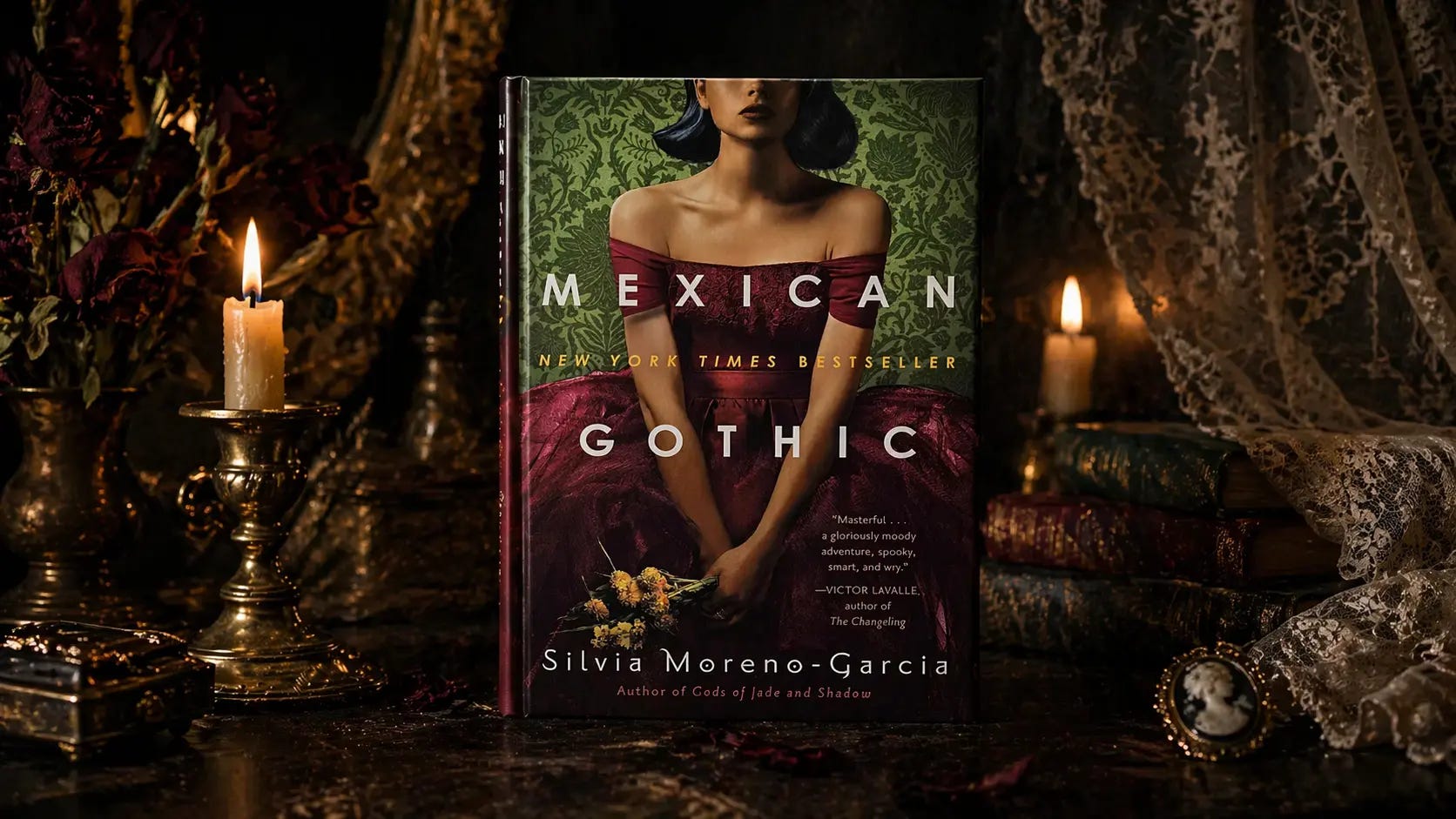
Spoilers ahead, because that’s just how I roll…
I knew early on that this was a writer in control. There is a scene where Noemí lies in bed at High Place and the walls seem to breathe. The house presses in, the air thick with rot and something older. It is lush and claustrophobic without tipping into parody. I was salivating.
Spoilers incoming. Don’t clutch your pearls later.
Gothic Literature
This is a novel that understands Gothic architecture, Gothic lineage, and Gothic rot. It understands colonialism as fungus and eugenics as entitlement dressed up as science. The Doyle family is not subtle, and that is correct. They are pale, damp inheritance made flesh.
I respect what this book is doing, but I wanted to feel trapped, injustice settling in my throat. In Dracula and Frankenstein, both Gothic classics, the horror stains everything. It is not just the monster. It is the cost of wanting power, of wanting mastery, of wanting to outrun death. In this novel, the rot is visible, but it mostly stays in the walls.
Noemí as Mary Sue
Noemí resists from the start. The house unsettles her, but it does not seduce her. She resists Virgil’s insinuations. Florence’s cold discipline does not impress her. Even when the mold seeps into her dreams, her core remains intact.
Her resistance is treated as a fixed trait. She is strong because she is strong. That kind of strength leaves me cold. I am more interested in the moment it bends, in the fracture that proves it is real.
Designated Strength
When Virgil corners her and insists she belongs to the house, the scene is disturbing. He wants her body as a vessel, her mind as soil. It is colonial logic in miniature. Ownership disguised as destiny. But Noemí’s defiance feels preloaded. She never misjudges him, never buys into the romance of the place, never makes a choice that costs her something lasting. Strength is more interesting when it misfires.
Compare that to Francis. Francis wavers. Francis is lonely enough to rationalize rot. His loyalty to the Doyles has curdled into self-preservation. He is weak in believable ways. When he bonds with Noemí, I believe the trauma. I believe two people breathing the same poisoned air and finding each other.
Precision Over Ruin
Noemí is vitality. Francis is decay with a conscience. They will balance each other. On paper, it works. On the page, it feels underdeveloped, forced.
The novel’s critique of colonialism and inherited power is sharp. Fungus as metaphor is almost too clean. The Doyles literally feed on land and blood. They refuse to dilute their lineage and call it superiority. It is just fear of extinction. That part sings.
The revelation that the patriarch’s consciousness persists through the mold, that generations were sacrificed to keep one white man alive, is grotesque and thematically precise. Colonialism as parasitism. Eugenics as cannibalism. A house that survives by consuming the young and brown.
I admire the clarity. What I needed was psychological causality that left bruises.
Noemí burns the house. She escapes and rescues Francis. Evil collapses under its own rot. Structurally, the novel is disciplined. Its symbolism is purposeful. Every message lands exactly where it intends to.
But when the smoke clears, I did not feel that anything irreversible had happened inside Noemí.
Yes, she has endured horror. She has seen the underside of aristocratic fantasy. Her sense of self does not fracture or darken. It does not compromise. She emerges intact.
I needed the cost to stretch past the final page.
Gothic Novels
Gothic heroines often face peril but maintain moral steadfastness. I understand the lineage Moreno-Garcia is working within. This is a deliberate reclamation of the genre.
Noemí becomes the brown socialite who will not be devoured, the colonized body that refuses absorption. There is power in that choice. But power without damage can start to feel like demonstration.
At times I felt like I was watching an elegant presentation of ideas. Colonialism bad. Eugenics monstrous. Patriarchy suffocating. All true. All effectively rendered.
I just wanted Gothic mess. Fear. Regret. A choice that stains.
I will add one petty note because I am human. In the audiobook, Noemí’s name was mispronounced. Repeatedly. I switched to the print edition. It did not change my feelings, but it did confirm that irritation can compound. Even Gothic atmospheres have limits.
Where it faltered for me was not in craft. It was in emotional abrasion. I needed her resistance to misjudge someone, her loyalty to cost her something lasting, one choice that felt like survival at the expense of what she loved.
Instead, I got a heroine who withstands corruption without internal corrosion.
Shelve Test: 2. For someone else: Not a flaw. Just a reader mismatch.
This is a well-written book, but it was not a good read for me. I admired it more than I felt it. And admiration in fiction is rarely enough to keep me haunted.
Book Details
Title: Mexican Gothic
Author: Silvia Moreno-Garcia
Published: June 30, 2020
Genre: Gothic Horror, Historical Fiction
Thank you for reading.
← Listening vs Reading, Who the Hell Cares? | Book Reviews | My Dark Vanessa →
Can a story impress you without haunting you?
Start Here: Beneath the Weight of Water | 1980s Fiction Saga

Lucia Perez lives in a house where anger is excused, silence is expected, and survival means staying small. She keeps her head down, studies hard, and holds on to one fragile hope: that education might be her way out.
Thank you for reading Beneath the Weight of Water. Paid subscriptions are optional support for future chapters, illustrations, and the long work of keeping the story alive.
Copyright © 2026 Angelica Thorne
For permission requests, contact angelicathorne@icloud.com.