

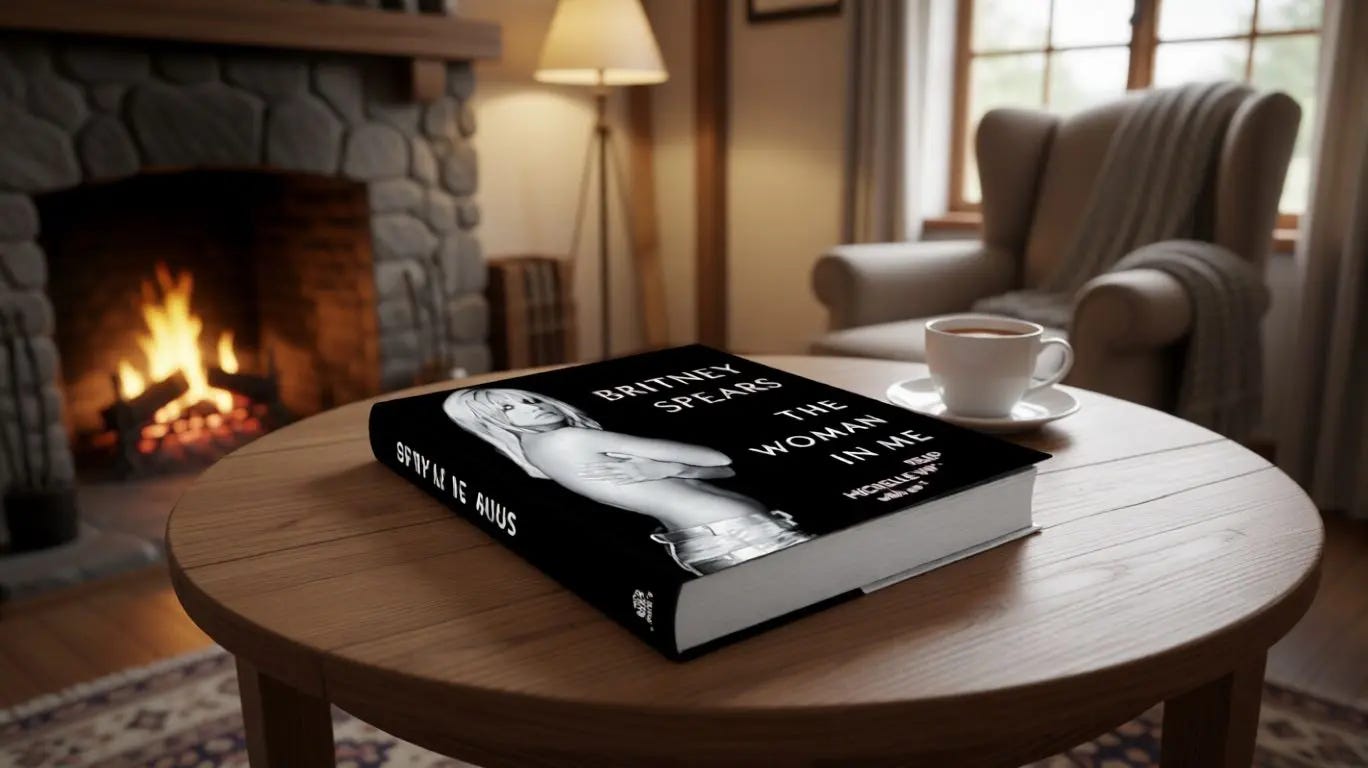
Careful—major plot tea is about to be spilled. Beyond this point live twists, turns, and zero apologies for looking beneath the pop-star veneer.
We need to talk about the modern obsession with manufacturing the immaculate survivor in celebrity memoirs. I picked up Britney Spears’s The Woman in Me hoping for a reckoning, a searing look at what happens when a human being needs the people morally and legally obligated to protect her, but they decide to treat her like a cash cow instead.
There is no question that Britney experienced profound abuse. Her family, the media, and a deeply broken legal apparatus colluded to strip her of her autonomy while spending her money. Yet, as I turned the pages of this book, a persistent friction kept pulling me out of the narrative. The prose works overtime to craft a version of events that feels sanitized, presenting a marketing campaign disguised as a raw confession.
I have a problem with memoirs that aggressively try to make an ugly situation prettier. I will have plenty to say about Open by Andre Agassi later.
The text goes to extreme lengths to establish Britney as a permanent, powerless observer in her own life. We see the external pressures clearly, particularly the agonizing revelation that Justin Timberlake pressured her into having an abortion. She describes the terror of that moment, but her narrative completely glosses over the reality of her own agency.
I thought about her younger sister, Jamie Lynn Spears. She got pregnant as a teenager, faced the immediate collapse of her Nickelodeon career, and chose to keep her child anyway. Britney possessed vastly more money, global leverage, and industry power at that point in her life than her teenage sister ever did. The book refuses to engage with that contrast because doing so would require acknowledging that Britney made a choice based on fear.
The Myth of Absolute Helplessness
Money, fame, and leverage do not cancel out fear, coercion, youth, or the suffocating pressure of a public image. Human beings are spectacularly bad at acting in their own interests when love and shame get into the room. Britney likely feared the social and financial price of keeping that baby just as much as Justin did, and that terror is deeply human.
The failure here belongs entirely to the book, which never allows space for the choice she made out of fear. Admitting that she was a participant in that agonizing decision would make her human, flawed, and complicated. Instead, the narrative demands that we see her as a completely innocent victim who never possessed a single shred of leverage.
This total avoidance of self-awareness becomes glaringly obvious when the narrative revisits her most chaotic years. Consider the infamous fifty-four-hour Las Vegas marriage to her childhood friend, Jason Alexander. The text frames the entire episode as a harmless, goofy joke born out of pure boredom, claiming the media maliciously blew it out of proportion.
Britney was a multimillion-dollar global enterprise, not an anonymous college student on spring break. Legally binding yourself to a random man on a whim is a spectacularly messy, poor choice. The book treats it like a minor misunderstanding, completely minimizing her own recklessness to maintain her status as a victim of public perception.
The trend continues when the book addresses her legendary clubbing era alongside Paris Hilton and Lindsay Lohan. The narrative paints her as a fun-loving, lost lamb who was merely trying to blow off some steam after her divorce from Kevin Federline. There is absolutely nothing wrong with a young woman drinking, partying, and making mistakes.
The issue is the manipulative way the text frames it in retrospect. It minimizes the sheer chaos of her lifestyle during those years, deflecting every ounce of blame onto the paparazzi. The predatory nature of the media was real, but the book refuses to acknowledge how her own choices actively fed the monster. It wants to act like she did nothing odd, pretending her behavior was perfectly stable while the world simply went mad around her.
The Marketing of the Perfect Victim
That refusal to look inward is exactly where the book fails as a memoir. Women are entirely allowed to contain contradictions. A woman can be innocent and still raise hell, but the narrative manipulates those identities to suit its immediate needs.
The structural tragedy of Britney’s life reminds me of Charlotte Perkins Gilman’s The Yellow Wallpaper. In that classic story, a woman is locked away by her husband under the guise of a medical cure for her nerves, and that isolation ultimately drives her into actual madness. The parallel here is sharp and devastating.
Gilman’s protagonist records her descent with a creeping, visceral terror. Britney’s memoir, by contrast, feels editorially polished to a shine. The prose keeps a defensive distance, prioritizing image rehabilitation over psychological truth.
The Flat Framing of Trauma
The most frustrating aspect of the book is its absolute flattening of her psychological reality. The narrative tries to present her story as if there were no internal mental health struggles or as if she never required professional support. I find it neglectful and inhumane to push the dangerous, sanitized narrative that any attempt to offer her help is inherently evil.
There is no question that misogyny stepped into Britney’s life and imposed a brutal, legal cure via the conservatorship, a system that broke her down further than her initial struggles ever could. The book shows how a room of patriarchal figures can lock a woman away, steal her labor, and convince the world it is for her own good.
Two things can be true at the same time: the conservators abused the system to control Britney, and she is psychologically fragile. By completely scrubbing any genuine psychiatric struggle from the text to make her sound perfectly orderly, the book misses an opportunity to normalize the very real, messy intersection of trauma and mental illness.
We have all failed this woman. Her family was predatory, her relationship with her children has been publicly strained, and her audience remains complicit. The public largely wants the Britney from the music videos: the eternal, hyper-sexualized pop princess who performs on command. They do not want to look at a psychologically fragile, deeply flawed, strong woman who survived without a genuine support system.
The memoir ultimately functions as a missed opportunity. It trades genuine survival prose for a marketing toolkit designed to transform her into the immaculate, blameless victim. I cannot tell whether she felt she had to justify her past actions to the public or desperately needed this revisionist history for her own internal peace.
The resulting text feels hollow, a defensive wall built to keep the reader from seeing the actual, fractured human being behind the pop star myth. We are left with a book that tells us everything about her prison but almost nothing about the woman locked inside.
Shelve Test: 2 – For Someone Else
A book cannot survive on the strength of its subject’s tragedy alone. If a memoir refuses to offer honesty, it is just public relations bound in cardboard.
Book Details
Title: The Woman in Me
Author: Britney Spears
Published: October 24, 2023
Genre: Memoir / Biography & Autobiography
Thank you for reading.
← To Old for This by Samantha Downing | Book Reviews | Next Book Review 07/06 →
Where do you draw the line between honoring a survivor’s story and expecting a memoir to show self-awareness?
Start Here: Beneath the Weight of Water | 1980s Fiction Saga

Lucia Perez lives in a house where anger is excused, silence is expected, and survival means staying small. She keeps her head down, studies hard, and holds on to one fragile hope: that education might be her way out.
Subscribe to The Grumpy Reader for book reviews that let women be complicated, trauma stay messy, and public relations stay allergic to hardcover.
Copyright © 2026 Angelica Thorne
For permission requests, contact angelicathorne@icloud.com.