

Spoilers incoming. Don’t clutch your pearls later.
I did not Choose this Book. Michael Gallagher Did.
Have you ever picked a book because of a narrator’s voice and then realized you just walked into someone’s fevered dream? That was this.
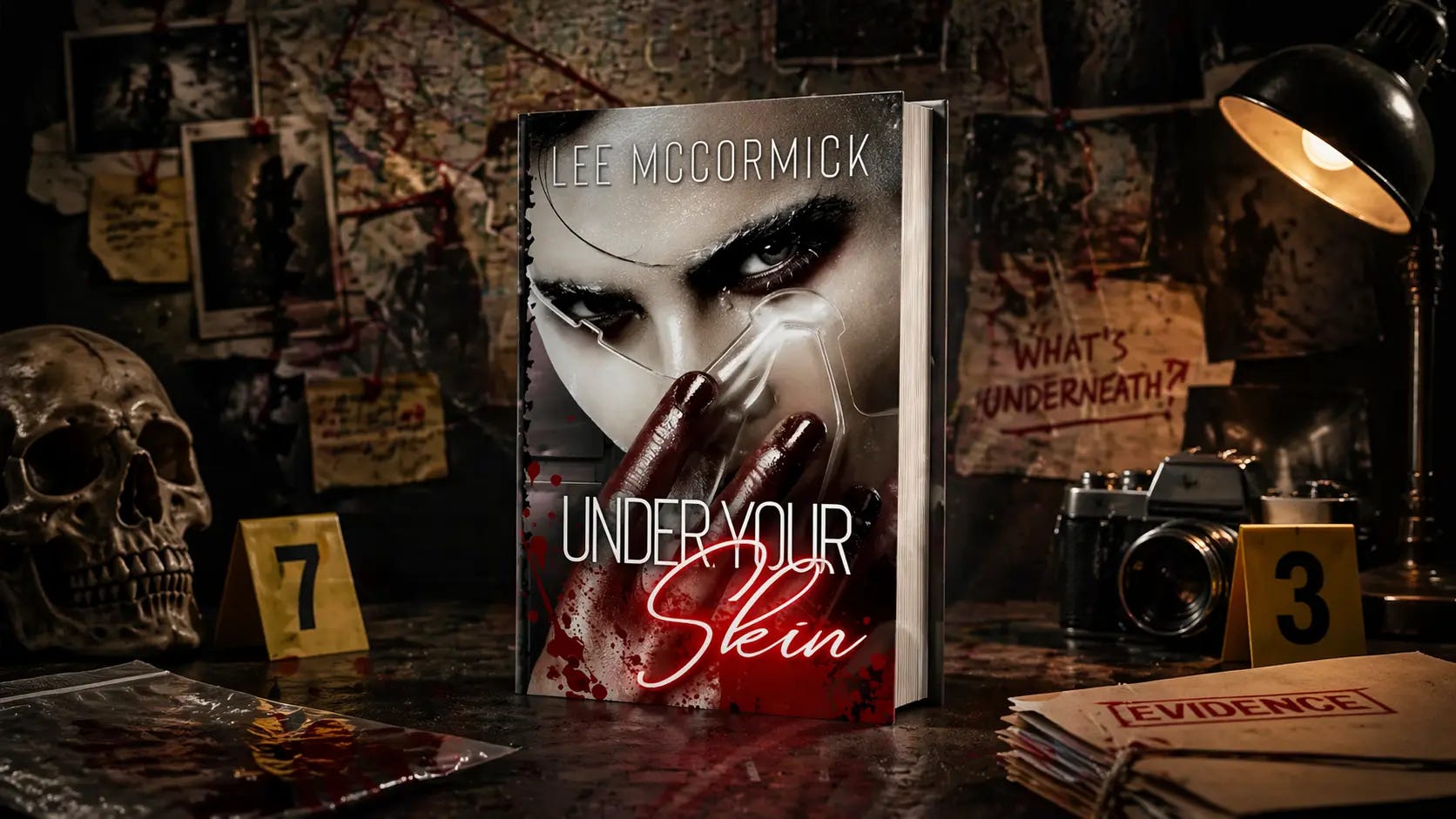
I fell down the narrator rabbit hole. Michael Gallagher ranks among my favorites. So, when I saw he narrated Under Your Skin, I skipped the synopsis. The cover had me expecting a story like Dexter.
You know what they say about assuming… Holy hell, this book is twisted. That may be exactly why it works.
This dual-POV dark romance follows a mortician who entwines himself with the man who killed his mother’s killer.
I could call it noir.
I could call it hot.
I could call it disturbing.
But I cannot call it simple.
Dark Romance Is Not Therapy, It Is Contract Play
This book is my first Dark Romance. I intentionally stayed away from the genre because of my personal experience with generational abuse. I didn’t want to be triggered. I wasn’t.
When you read dark romance, you commit to a contract of sorts. Accepting lunacy is the first step, along with consent to psychological transgression. A clear distinction between abuse and rough, consensual sex, along with the recognition that some people enjoy sadomasochism is essential. If you do, you may find yourself seduced by it.
In Under Your Skin, the violence functions as fantasy scaffolding, not as relational harm between the protagonists. The author draws you into Levi’s orbit and shows how he has carried his trauma for most of his life, only to transfer that intensity onto Jonah. That transfer is how the connection becomes erotic.
Levi Is Not a Victim. He Is a Reader of Violence.
Levi starts broken after witnessing his mother’s murder. He buries that trauma in funeral work and in his relationship with the dead. A pattern of marks emerges across the bodies. He reads each one like a message meant for him, a pattern that pulls him toward the man who took vengeance on his behalf.
Twisted but not random. His fixation on Jonah is not fetishization for its own sake. It is a kind of narrative inevitability based on Levi’s interior life.
And here is where it gets structurally interesting. This is not a tale of a traumatized child saved by love. It is a tale of a traumatized man who finds himself reflected in danger and then claims that reflection as agency.
Levi chooses Jonah. He chooses danger and obsession, and never abdicates that choice. That is not passivity. It’s purpose.
This is a control fantasy where the protagonist gets to decide his own damn future even when the mechanics of that future are dark. Levi’s decisions carry consequences. They are his. That mattered more to me than the violence that surrounds them.
Jonah Is Possession Wrapped in Violence Who Never Crosses Into Abuse
Jonah is simply a serial killer in the genre sense. There is no pretense that he is a nuanced moral agent. He kills. He does so often. He targets bad people not because they are bad but because they are convenient. He doesn’t need justification. So he is not quite Dexter. Jonah is more honest.
Levi has no problem with this because the violence takes place in a world he has already decided is morally corrupt. The murders that underpin the plot are part of the story’s context, not relational harm.
The sexual violence in the book is consensual and negotiated. In this context, Levi never suffers at Jonah’s hands. That distinction is psychologically coherent, not accidental.
The Age Gap
The age difference made me uncomfortable. Yes, they are both consenting adults, but Levi is in his twenties, and Jonah is in his thirties. There is a world of difference in maturity and sophistication, and, more significantly, experience between the two.
Levi may be younger, influenced by trauma, and obsessed, but he is not acted upon. He acted. Jonah may be older, a serial killer, and intense, but he did not subjugate him.
That keeps the relationship from collapsing into something unpalatable. That is why I stayed and even rooted for them.
Dual POV Is Structural, Not Decorative
This book’s dual POV is vital. Being inside both minds explains the obsession on of both sides. It prevents Jonah from being a flat villain, a killer archetype. It prevents Levi from being a passive observer drawn mysteriously into danger.
You see them both choose each other. It eliminates vagueness. That creates agency.
There were only a couple of lines that felt like overblown caricature amid all the interior richness.
Everything else earned its place.
Moral Detachment Does Not Equal Emotional Engagement
Yes, the world in the book is corrupt. The police and town authorities look away. We all want to believe that this space is fantasy because the moral rules of normal society do not bind the protagonists. We don’t need fantasy to make moral detachment possible. Detachment has become a form of survival.
But let’s face it, our government has failed to protect us. Rapists go free. Children listen for the sound of guns in our schools. Racism is condoned by elected officials. Reality feels more dystopian with every passing day.
The book offers catharsis in which the bad actors get what they deserve. I settled for purposeful choice amid horror.
This Book Is About Choosing Your Own Wrongs
I walked in expecting Dexter vibes. I left with an appreciation for a genre that lets characters choose their moral transgressions and live with them. That is not universally appealing.
And maybe it is not “healthy” in the everyday sense. But it is psychologically resonant, and the book leans into that without apology.
That is what hooked me.
That same pull makes Under Your Skin fascinating beyond genre.
Shelve Test: 4 – Loved.
Agency wrapped in blood still counts as agency.
Book Details
Title: Under Your Skin
Author: Lee McCormick
Published: May 21, 2024
Genre: Dark M/M Romance, Crime Romance
Thank you for reading.
← Previous Essay | Table of Contents | A Separate Peace →
Why do you read Dark Romance?
Start Here: Beneath the Weight of Water | 1980s Fiction Saga

Lucia Perez lives in a house where anger is excused, silence is expected, and survival means staying small. She keeps her head down, studies hard, and holds on to one fragile hope: that education might be her way out.
Thank you for reading Beneath the Weight of Water. Paid subscriptions are optional support for future chapters, illustrations, and the long work of keeping the story alive.
Copyright © 2026 Angelica Thorne
For permission requests, contact angelicathorne@icloud.com.