


I love my 1985 copy!
Forever Finny’s
I first picked up A Separate Peace by John Knowles as just one more assigned book. I planned on giving the teacher what she wanted and moving on. That was my usual move as a high school student. Then Finny walked in, and everything quietly fell apart.
There was a boy back then. A ballet dancer. He moved through the hallways as if gravity barely held him. Perfect posture, shoulders open, chin lifted, as he glided past us. There was something unreal about the way he carried himself, removed from the rest, even though he charmed us all, or maybe because of it.
I responded to his athleticism and charisma, but what stayed with me was the way he existed in his body without apology. He did not perform for approval. What he offered was simple presence. That felt rare even then, especially when everyone around me seemed to try so hard to be seen, liked, chosen.
I linked the ballet dancer and Finny without asking permission from either. They carried the same kind of presence. Or maybe I reshaped Finny into the dancer. Memory is slippery like that as I approach sixty.
Still, the connection never really left me. It changed shape and waited for me to catch up.
Turn back now or forever hold your peace. Spoilers ahead!
The Pattern Repeats
I picked up A Separate Peace decades later, this time with my teenage daughters. I expected them to react differently, to read the book with more distance than I had, to shrug and move on. Different generation. Same pull.
They noticed Finny immediately.
No dramatic sighs. It showed up in the way they leaned in when he was on the page, the way their tone softened when they talked about him. I didn’t need them to explain it. I had already lived it.
I sat there thinking I should have something insightful to say about that as a parent and retired academic. Something about literature, or maybe adolescence, or timeless characters. Instead, I realized I was watching the same quiet attachment form in real time.
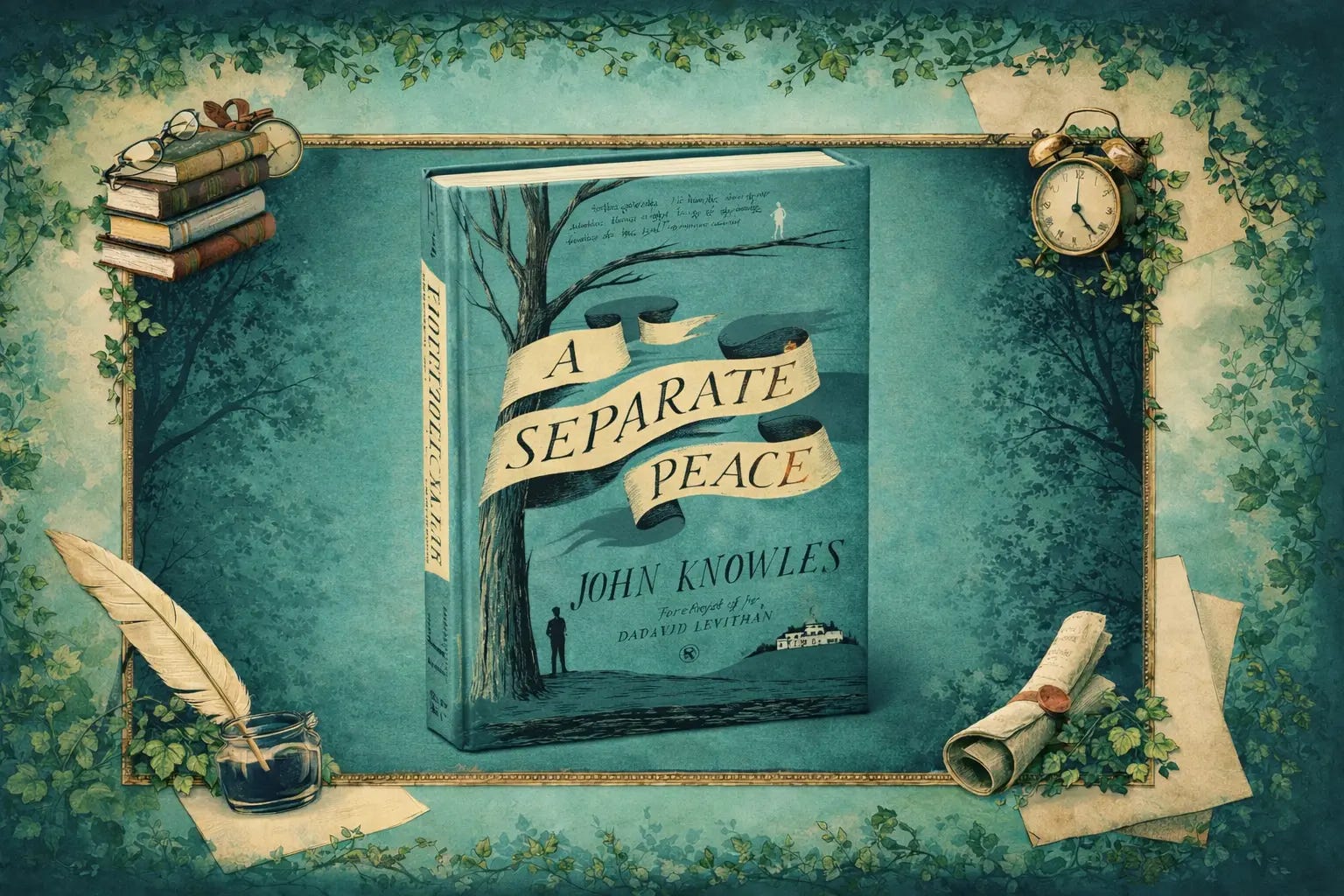
The cover of the book I read with the girls strips the story of
its tension and specificity.
Girls’ Response
So, I started paying closer attention. Not to the plot, but to Finny. What exactly were we all reacting to?
Finny moves through the world in a way that feels easy. He doesn’t scan the room to see how he’s landing or adjust himself to fit expectations. Most teens carry self-consciousness like a second backpack. He speaks, acts, and exists without it.
At that age, you’re watching yourself from the outside, measuring, correcting, trying to get it right. Then you meet someone who doesn’t seem to be doing any of that. He just shows up as himself and keeps moving.
At first, it reads as confidence. Over time, it feels like safety. He brings no games or testing. He gives his attention freely, and that kind of attention is rare when you’re used to earning it in small, exhausting pieces.
Now I can see it more clearly. Finny offers a version of masculinity that doesn’t rely on distance or control. He makes space instead of taking it. Few boys actually get to grow into that without being taught to shut it down. That lands harder than people admit when you sit with it.
My daughters didn’t try to break this down. Neither did I at their age. You don’t analyze it. You respond to it.
The Shift
When I think about Finny now, I don’t lean toward him the way I did as a teenager. Something heavier took its place, an experience I didn’t have access to back then.
The ballet dancer I knew died in his early twenties. There’s no graceful way to place that into a conversation about a book. It doesn’t fit neatly or soften with time. Nothing about it does. It just sits there, changing the way everything around it reads.
Now Finny feels unfinished. He never gets the chance to become anything beyond what we see on the page. The same way that ballet dancer never got the chance to grow into whatever he was already starting to be. That’s the part that stayed with me.
I’m not just remembering who I was when I first read it. I’m remembering him. The ballet dancer moving through the hallway like nothing could touch him. Now I see that life has an ugly way of interrupting that kind of certainty, whether or not we are ready. We never are.
Once you experience this, you don’t get to go back to reading Finny as if he will remain untouched.
The Fall
The moment that now travels with me it’s the fall because there’s something brutal about being hurt by someone you trust. Not just the act itself, but the way it forces you to rewrite the relationship in your head. You either accept what happened and lose the person, or you soften it and stay. That choice doesn’t feel noble. It feels necessary.
Finny chooses to stay.
That moment lands differently once you’ve lived long enough to recognize it outside of books. People forgive things they shouldn’t all the time. They minimize, reframe, and convince themselves it wasn’t as bad as it felt in the moment. Not because they’re weak, but because walking away would cost more than they’re ready to pay.
Gene sits on the other side of that.
What unsettles me now isn’t that he moves the tree limb, but his resentment toward Finny. Gene’s belief that someone else’s ease must be a threat. Finny isn’t competing with him. That doesn’t matter. Gene is competing anyway.
I’ve seen that dynamic play out in real life more times than I can count. As a professor, I had students convinced I disliked them, that I was judging them, that I had already decided their place in the class. Meanwhile, I was keeping track of five sections, around two hundred and twenty-five students.
The version of me these students reacted to didn’t exist anywhere but in their heads. That didn’t make their reaction any less real. Gene lives in that space. The imagined version of reality becomes the one he acts on. Once that happens, everything else follows. That’s the part that should bother us. Because it means he’s not unusual.
Finny’s Gift
What makes Finny special isn’t just his presence. It’s the way he sees the world. He finds goodness without having to dig for it. Then he reflects it back to people as if that’s the most natural thing to do.
People like Finny move through life without building the same defenses the rest of us rely on. They trust easily and give themselves fully. It’s a beautiful way to exist. That same openness leaves them exposed in ways they can’t see coming. Their mistake is that they assume connection where others assume competition.
The instinct to protect someone like him didn’t exist when I first read the book. It does now, and it changes the way every scene lands. I find myself waiting for someone to step in, to recognize what he is and shield him. No one does.
His “specialness” moves through the world unguarded, as if that alone should be enough to keep him safe. It isn’t. He has no buffer at home or school. Unsurprisingly, he gets hurt twice.
When I raised my own kids, I tried to protect what makes them open and willing to see the good in people. At the same time, teach them how the world actually works, because that’s another kind of protection. Balancing those two things is harder than it sounds.
Give them too much protection and they don’t learn how to navigate reality. Give them too little and they get hurt in ways that stay with them.
Finny never gets the chance to figure that out.
Carrying Finny Forward
Girls will always be drawn to someone like Finny. Not because he’s safe. He isn’t. This book makes that clear in ways that are hard to ignore once you’ve lived a little longer. Still, there’s something about the way he moves through the world that feels necessary, especially at that age when everything feels uncertain and a little too loud.
Life doesn’t exactly reward openness. It tests it. Health issues that don’t resolve the way you hoped. Plans that stall. A dog that needs more care than you expected. Things pile up quietly and make it tempting to narrow your world just to get through the day. That’s where Finny shows up for me now.
Not as a person, but as a way of seeing. Look for what’s still good. Hold on to it. Reflect it back when you can. It fixes nothing and doesn’t prevent what’s coming next. But it changes how we move through it.
Shelve Test: 5 — Cherished
Because Finny started as a crush and ended as something I’m still trying to live up to.
Book Details
Title: A Separate Peace
Author: John Knowles
Published: 1959
Genre: Literary Fiction / Coming-of-Age
Thank you for reading.
← Under Your Skin by Lee McCormick | Book Reviews | Heated Rivalry by Rachel Reid →
Have you ever made yourself feel less to keep someone in your life?
Start Here: Beneath the Weight of Water | 1980s Fiction Saga

Lucia Perez lives in a house where anger is excused, silence is expected, and survival means staying small. She keeps her head down, studies hard, and holds on to one fragile hope: that education might be her way out.
Thank you for reading Beneath the Weight of Water. Paid subscriptions are optional support for future chapters, illustrations, and the long work of keeping the story alive.
Copyright © 2026 Angelica Thorne
For permission requests, contact angelicathorne@icloud.com.