

Author’s Note: This essay is not a response piece. It is a reckoning with my own writing choices, shaped by fear, access, and consequence. The TikTok referenced here was the catalyst, not the subject.
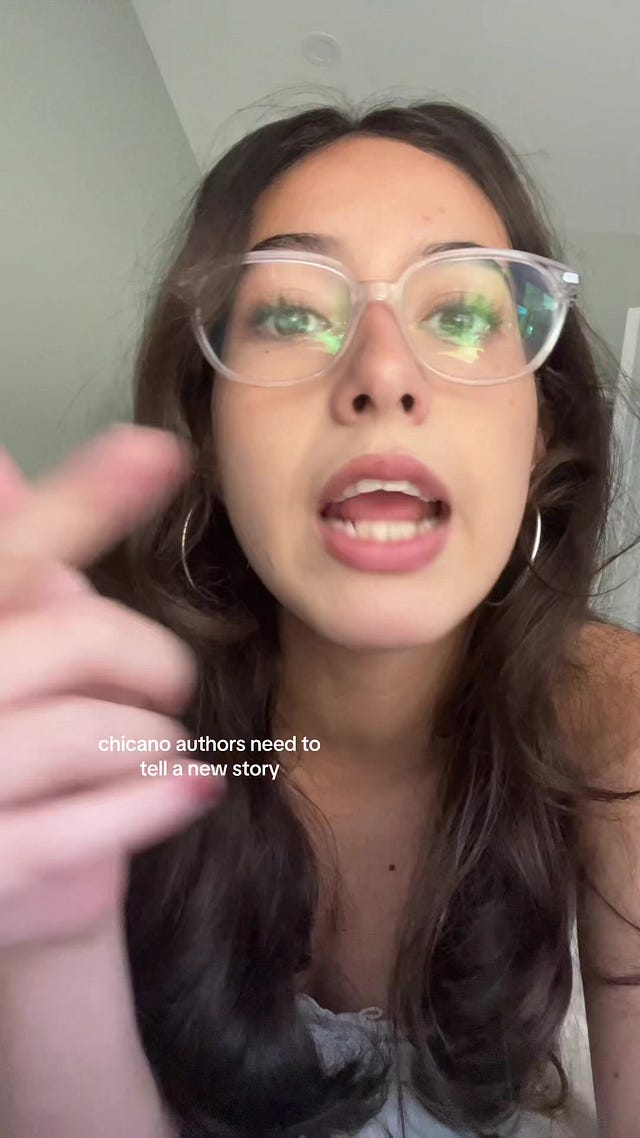
When I heard @zerochickss on TikTok say, “I don’t like Chicano authors. I don’t like your books. I don’t want to read your books,” my first reaction was physical. Heat. A tightening in my chest. The instinct to brace.
She went on to name what she was tired of: The same YA arc. The same “neither here nor there” confusion. The same cousin jokes about tacos. The same self-insert narratives that refuse to name citizenship, class insulation, or regional safety. The same characters asking readers to empathize while pretending privilege does not exist.
Her full commentary is here, and it matters that readers hear it directly:
 Tiktok failed to load.
Enable 3rd party cookies or use another browser
What unsettled me was not her anger; it was how much of her argument made sense.
I did not rush to defend Chicano or Mexican American writers. I did not rush to distance myself from them either. What I came to recognize, slowly and uncomfortably, was that my own writing life had been shaped by the same pressures she was naming. I just responded by disappearing, not contributing to the criticism.
For years, I refused to write Mexican American characters at all.
This was not an aesthetic choice. People like to frame representation as courage or cowardice. As presence or absence. As if writing identity were a switch you flip once you find your voice. That framing ignores how writers actually survive.
I did not avoid Mexican American characters because I thought those stories were unworthy. I avoided them because I understood what visibility costs. I had lived in enough states, classrooms, and institutions to know how quickly attention can turn punitive. I had seen what happens when Mexican Americans become loud, organized, or simply noticeable. Visibility invites response. Response escalates. Consequence arrives wearing the costume of neutrality.
When I began writing seriously, I made a calculation that had nothing to do with art theory. I could write characters whose race and culture were clearly legible and accept that their existence would be read as political, niche, or dangerous. Or I could write characters whose markers were muted enough to pass without scrutiny. Characters who could move through narrative space without triggering suspicion.
I chose the second option.
That decision bought me access. It also narrowed the field of consequence. My characters were allowed complexity because they were not asked to represent anyone. Editors were interested, and I received two traditional publishing offers. I told myself I had made a good marketing choice.
But–
I didn’t take those offers because I did not have time. Life was busy. School. Love. Children. Writing required a level of commitment that I could not justify. That explanation was convenient. (I said it so much that I almost believed it.)
The truth was simpler and harder. Neutrality was not the truth. It was safety dressed up as objectivity. It was a refusal to test whether the work could survive once it stopped hiding.
Neutrality Is a Fiction That Protects the Writer
One of the strongest parts of the TikTok critique is the accusation of self-insertion. That these books feel like memoirs in disguise, demanding sympathy without accountability.
What this critique misses, is that erasing identity does not erase the author. It only hides the conditions that shaped them.
There is no neutral character. There is only unexamined context.
Every character reveals what the author believes is survivable: Who can speak without being punished. Who can move freely. Which mistakes are fatal and which are recoverable. Even when race is unnamed, it is present in what the story allows.
When I wrote culturally vague characters, I was not avoiding self-insertion. I was disguising it. I embedded my own survival logic without naming its source. That made the prose more palatable to the general reader. It also made it less honest.
Sophisticated readers, those who read with their mind and heart, can feel that smoothness. It reads as distance, a withholding, and now something missing.
On the other hand, the books being criticized fail not for centering identity, but for refusing to examine the conditions that make their version of identity safe enough to narrate. Citizenship is treated as invisible. Regional protection is treated as universal. Class insulation is treated as baseline. The story wants the ache of displacement without acknowledging the scaffolding holding the narrator up.
That gap is what readers react to.
Assimilation Is Not a Theme. It Is a Plot Engine.
For most of my life, assimilation was framed as signs of maturity, discipline, and proof of intelligence. You learned when to speak, how to soften your presence, which parts of yourself to edit. You learned that excellence was a shield.
Those beliefs did not emerge in a vacuum. They came from social systems shaped by prejudice and racism. And from family systems shaped by colorism and fear. From watching who was protected and who was not. From understanding that silence sometimes worked.
Assimilation was not betrayal to me. It was strategy.
What I did not understand then was that assimilation is not a neutral background choice. It generates stories by rewriting muscle memory, delaying consequence rather than eliminating it.
By refusing to write Mexican American characters, I was refusing to write that plot honestly. I was flattening the mechanism that shaped my own life and writing. I was choosing calm over accuracy.
The Risk Was Not Only External
There is a second pressure that often goes unnamed. There is a risk of writing from within your own community, beyond marketability, for a larger audience.
Expectations harden fast. Variations in representation are often read as disloyalty. Complexity is treated as harm. Writers are asked to perform gratitude, rage, or clarity on command. Too much anger is dangerous. Too little is betrayal.
I watched writers punished for refusing easy narratives. I watched others rewarded for packaging pain in socially-friendly ways. I learned which stories were legible and which ones stalled careers.
So when I stayed silent, it was not because I thought my story was insignificant. It was because I understood how it would be received from all directions. Outside readers would flatten it. Inside readers would police it. The craft would vanish under interpretation.
Silence felt safer.
It was also corrosive.
Why the “Neither Here Nor There” Story Will Not Go Away
This is where I partly diverge from the TikTok critique. The repetition she names is real. The exhaustion is earned. But the persistence of that narrative is not laziness.
It is unfinished business.
Mexican American identity shifts by generation, region, skin tone, accent, and class. Life inside an enclave is not the same as life outside it. Passing changes the stakes. Education changes exposure. Safety is uneven and conditional.
Even at 59, I can go from being deliberately mistaken as the waitress to being called the smartest “Mexican ever” when others find out I have a PhD from a reputable university.
Writers return to this territory because it keeps changing. Because the consequences arrive late. Because each generation believes it has escaped something, only to discover what it brought with it.
The problem is not that the story exists. The problem is that too many versions refuse to advance it. They circle recognition without naming cost.
Privilege Must Be Named or the Story Lies
Where the critique lands cleanest is here. Stories that refuse to name privilege are dishonest. Citizenship matters. Geography matters. Class matters. Safety matters.
If a character can afford introspection without fear of surveillance, that is not universal. If their cultural confusion is cushioned by community acceptance, that is not neutral. It is protection.
When writers erase those conditions, they ask readers to empathize without context. That reads as self-victimization. That reads as indulgence.
The solution is not to abandon these stories. It is to write them with structural honesty. To show what choices buy safety and what they cost later.
I Stopped Hiding
I did not begin writing Mexican American characters because it felt brave. I did it because erasure had begun to rot the work. The stakes felt artificial. The silences were doing too much labor.
More importantly, consequence stopped being theoretical. Political shifts made it clear that disengagement does not protect. Silence delays impact. It does not prevent it.
I watched people who believed themselves exempt discover otherwise. I watched as assumed protections vanish. I watched denial harden into disbelief.
At some point, the cost of hiding was the complete loss of myself as a writer, as a human being, a woman, a Mexican-American.
Identity Is Not Optional
This is the truth underneath both my own earlier choices and the books being criticized. Identity is not a vibe. It is not branding. It is not a wound you perform for legitimacy. It is a set of constraints that shapes what is possible.
Writers who pretend they can step outside that context are lying to themselves. Writers who exploit it without naming their insulation are lying to readers.
I refused to write Mexican American characters because I thought erasure would buy safety. It bought time. That is not the same thing.
What I Am Actually Arguing For
I am not asking readers to lower standards. I am not asking critics to soften their anger. I am not asking writers to turn fiction into memoir.
I am asking for honesty about constraints.
Write assimilation as a choice with a cost. Write privilege as a condition that alters the consequence. Write identity as negotiation under pressure, not worn as decoration.
If that makes the work harder, it should.
The stories worth telling are not self-serving. They are accountable. And accountability, unlike safety, cannot be faked.
This essay is the first of an ongoing ten-essay series.

Beneath the Weight of Water | Serialized Literary Fiction

Lucia Perez lives in a house where anger is excused, silence is expected, and survival means staying small. She keeps her head down, studies hard, and holds on to one fragile hope: that education might be her way out.
Table of Contents


Extremely well thought out introspective and communicated
professionally. You should do a TikTok response to @zerochickss