

Author’s Note: I read this play as someone raised inside obligation, not outside it. This is not a moral reading. It’s a cultural one. If the ending made you uncomfortable, good. That discomfort is doing the work.
Spoilers ahead—because obviously.
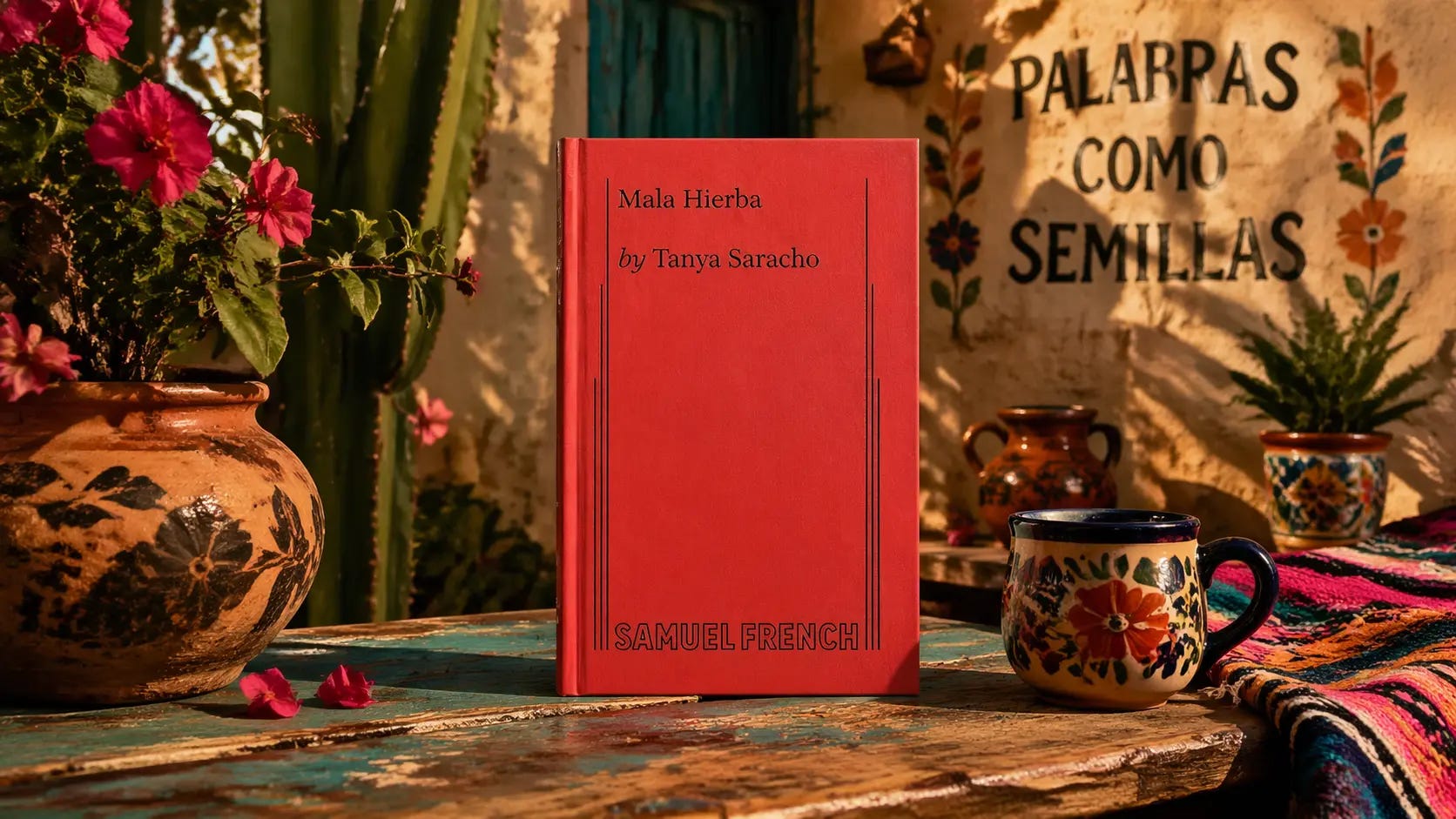
I picked Mala Hierba because my daughter loves plays, and because Tanya Saracho writes women in a way that refuses easy virtue.
Power doesn’t always mean escape. Sometimes it means staying, choosing, and refusing to apologize.
I’m not really into plays. I read Mala Hierba because my daughter at NYU loves Tanya Saracho’s work. I stayed with it because I’m trying to understand how women’s stories are told, especially by Mexican American women.
Then I realized that I came in sideways, through Vida on Starz, which Saracho also created. And that’s how this happened: me, reading a play I probably wouldn’t have picked for myself, in a reading format I don’t prefer, only to realize halfway through that I knew this woman.
Not in the “relatable” way. In the “twenty-year-old me is in this room and she has no idea how many versions of herself she’ll have to kill to survive” kind of way.
The Plot Isn’t the Point
Set in the Rio Grande Valley, most of the story unfolds in the master bedroom, velvet and glass, with a panic button hidden near the bed. Both sanctuary and cage.
Mala Hierba centers on Liliana, the beautiful, trophy wife of a border magnate (read: narco). We find out Liliana’s marriage is violent, but she stays because she supports many people with her silence: her ill parents, her sister’s education, and even Yuya, the elderly housekeeper who raised her.
Liliana is preparing for her husband’s birthday party when Maritza, her ex-girlfriend, shows up. A butch artist from Chicago, a reminder of who Liliana used to be, and maybe still is.
Maritza offers an escape. But escape is never free.
Liliana has a choice to make.
The Ending Everyone Saw Coming… Except Me
So Maritza tries to convince Liliana to leave. She pushes. Hard. And Liliana snaps.
She kills her.
Blunt force trauma, head bashed in. It’s a shocking moment, and somehow… not shocking at all.
What surprised me was what Liliana did after.
She went home.
Excuse me?
There, she finds that her husband has apparently cut off his own daughter, Fabiola. So Liliana does what women in our culture are trained to do: she steps in.
She finds the child she was never allowed to have.
She decides to raise her. Yes, a twenty-something raising another twenty-something.
Not with kindness, but with direction.
She will take care of her. Tells her to go back to school. Take her freedom.
Liliana takes control, not in rebellion, but in reclamation.
And just like that, Liliana isn’t the trophy wife anymore. She’s the matriarch.
Mexican Culture Is Not a Straight Line
This play explores patriarchy, yes. But not in the way outsiders expect. Mexican womanhood isn’t a single lane. It’s full of contradictions. Marianismo coexists with dark humor and reverence with rebellion. The Virgin and La Malinche are the truth in the same breath.
Liliana is not just a victim of her husband’s power. She’s also a strategist in a system that rewards her silence. She knows exactly what she’s doing and what it costs.
She Didn’t Lose. She Chose.
You could argue she gave in to cultural norms. That she went back to a violent man and killed the woman who offered her freedom.
But I don’t think that’s the story Saracho is telling.
She doesn’t perform guilt for anyone.
She sees the game, sees the players, and takes her place at the head of the table.
Maybe that’s not liberation.
But it’s not powerlessness either.
Lost in Translation
The play’s title is taken from the Mexican idiom “Mala hierba nunca muere.” Most English translations call it “a bad seed never dies.”
Mala hierba means weeds. Unwanted, walked on, ripped out, and sprayed with chemicals. They’re supposed to die.
But–
They’re resilient. Come back time after time. Bending, wilting, but never dying.
That’s every woman I know who has smiled through control, smiled through silence, smiled through the hollow praise of being called strong.
That’s Liliana.
Shelve Test: 5 – Cherished.
Because sometimes power doesn’t mean breaking free. It means taking your own damn throne.
Next week: something lighter. Or not. Depends how pissed off I still am.
Book Details
Title: Mala Hierba
Author: Tanya Saracho
Published: May 18, 2017
Genre: Drama, Play
Thank you for reading.
← The Audra Winter Debacle | Book Reviews | Listening vs Reading, Who the Hell Cares? →
Would you choose freedom over duty?
Start Here: Beneath the Weight of Water | 1980s Fiction Saga

Lucia Perez lives in a house where anger is excused, silence is expected, and survival means staying small. She keeps her head down, studies hard, and holds on to one fragile hope: that education might be her way out.
Thank you for reading Beneath the Weight of Water. Paid subscriptions are optional support for future chapters, illustrations, and the long work of keeping the story alive.
Copyright © 2026 Angelica Thorne
For permission requests, contact angelicathorne@icloud.com.