

Author’s Note: This piece reflects how I argue with books I enjoy, follow character logic to uncomfortable places, and don’t read to win debates or perform taste.
Disagreement is welcome. That is half the fun.
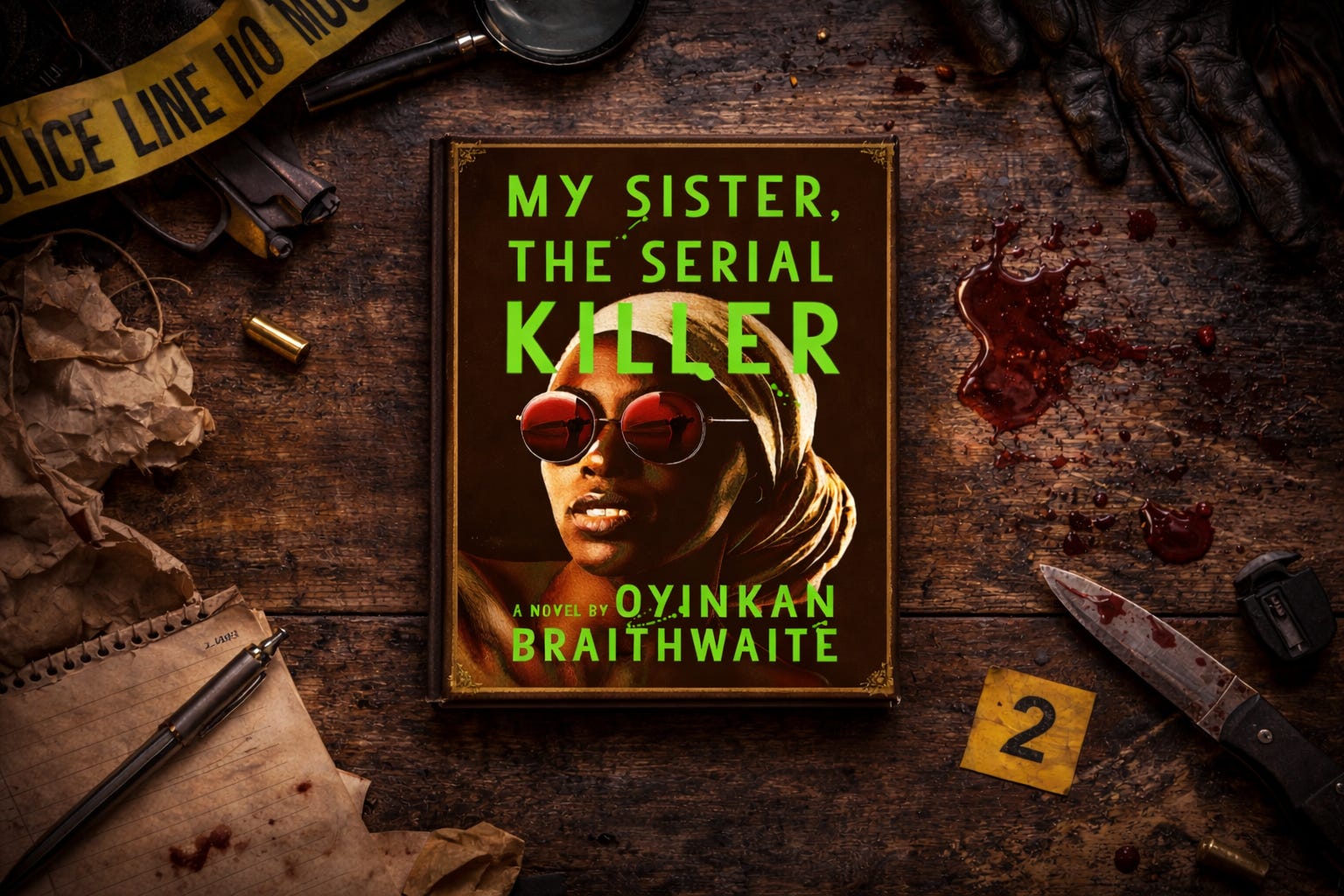
Spoilers ahead, because that’s just how I roll…
A darkly funny thriller about a murderous sister becomes a story of loyalty pushed past reason. In My Sister, the Serial Killer, beauty is evidence, silence is consent, and love turns dangerous.
Sisterhood, beauty, and the quiet ways loyalty rots into complicity
Why did I pick up My Sister, The Serial Killer by Oyinkan Braithwaite?
Was it because the Barnes & Noble assistant, who reads an average of 200 books a year, recommended it? Does the girl have time to breathe?
Or was it the cover, which stood out in a sea of flowers and cutesy cartoon trends? Maybe that had a little something to do with it.
But mostly, I chose it because of my twin daughters.
One has no filter and loves to throw around phrases like: I’m going to kill you! I’m going to kill them! They deserve to die!
Meanwhile, her sister is always running after her, trying to get her to tone it down, because no one knows that she’s autistic (yeah, blame it on Tylenol) and just take her words seriously.
The reality? This same girl has to call her RA to get rid of bugs in her dorm room because she refuses to step on them. But there you have it.
Back to My Sister, The Serial Killer: Sisters Raised Under the Same Roof, Damaged in Different Ways
The sisters have internalized their father’s misogynistic abuse in very different ways.
Korede, the eldest, has become hyper-responsible for her younger sister, constantly suppressing her own desires and well-being for the sake of the family. Not surprisingly, as a natural caregiver and nurturer, she becomes a nurse.
At the hospital, she works alongside Tade, a doctor who sees her only as a friend. Why? Because Korede has absorbed the image her family has painted for her. She’s too plain, too skinny, too smart, etc.
Ayoola, on the other hand, is beautiful. We know because, well, because everyone tells us so. Constantly.
More importantly, she’s learned to weaponize that beauty as a way of punishing their now-dead father. She can’t imagine a man seeing her as anything more than a commodity, just like he did. Every murder she commits is reframed as self-defense against “controlling men.”
Her twisted form of agency is what ultimately drives the story toward its climax.
The Moment Everything Shifts
Ayoola is emotionally detached from the murders. Until she finds out Korede has a thing for Tade.
Now, you can interpret Ayoola’s conquest of Tade in a few different ways:
She doesn’t want anyone getting between her and her sister.
Maybe she takes Tade just to rub it in Korede’s face.
Or she wants to protect her sister.
Maybe you can come up with more. Share in the comments below.
Personally, I went with option 3: she does it to protect her sister.
Ayoola’s deep distrust of men leads her to warn Korede that Tade will never truly appreciate her because he’s like all the rest: just interested in shiny objects. And, of course, Tade proves her right by immediately falling for Ayoola’s self-effacing, frivolous image instead of valuing the friendship, support, and selflessness Korede offered.
That betrayal is silent. Never acknowledged. Which makes it worse.
The Story Takes a Wrong Turn
The story gets a little silly. Korede has spent her entire life choosing Ayoola over their father, over conventional morality, even over basic survival. But now we’re supposed to believe she’s seriously considering saving Tade at Ayoola’s expense.
Korede does everything she can to warn Tade that he’s in danger. She tells him about some of the men Ayoola’s killed. Or… does she? Because if Korede really wanted to save him, she could have gone to the police. But she doesn’t. After all, the girl’s not a martyr.
Tade? Unsurprisingly, he doesn’t believe Korede. Why? Because Ayoola is just that good-looking. And let’s be real: the sex must be great if he’s willing to ignore the warnings of a trusted colleague, friend, and the sister of the woman who may or may not have murdered multiple men.
Beauty and sex trump reason.
The Ending
And sure enough, in the climax, Ayoola tries to kill Tade and fails. Korede runs in to help, but help whom?
Korede backs up Ayoola’s explanation.
Ayoola was the one bleeding. And she’s a beautiful, defenseless woman. So she is believed for the same reasons Tade believed her.
Tade gets fired. And Korede? She starts to step into her power at work.
The internet experts tell me that Korede is on a subverted or failed redemption arc because she never truly breaks free from her sister.
I disagree.
I think Korede’s story embodies a corruption arc, because she commits to a destructive lie: Ayoola comes first.
Korede does not fail to escape. She chooses not to.
Korede keeps choosing her sister over everyone else, even Tade.
You could argue that’s not entirely true, because she does try to warn him about Ayoola’s murderous tendencies. But does she, really? She shows him no proof. And when Tade ends up leaving the hospital under investigation for assaulting Ayoola, Korede doesn’t seem all that broken up about it.
Maybe, in the end, she’s been persuaded by Ayoola’s worldview. Men aren’t looking for substance, just the next shiny object.
If you’ve read the book and disagree with my interpretation, good for you! Drop your thoughts in the comments.
And remember.
Reading for fun isn’t about being right…
It’s about enjoying the ride.
Shelve Test: 4 – Loved.
Because sometimes loyalty isn’t a virtue. It’s just trauma with good aim and bleach in the trunk.
Book Details
Title: My Sister, the Serial Killer
Author: Oyinkan Braithwaite
Published: November 20, 2018
Genre: Literary Fiction, Thriller, Crime Fiction
Thank you for reading.
← I’m Not an English Professor | Book Reviews | The Audra Winter Debacle →
When does loyalty become betrayal?
Start Here: Beneath the Weight of Water | 1980s Fiction Saga

Lucia Perez lives in a house where anger is excused, silence is expected, and survival means staying small. She keeps her head down, studies hard, and holds on to one fragile hope: that education might be her way out.
Thank you for reading Beneath the Weight of Water. Paid subscriptions are optional support for future chapters, illustrations, and the long work of keeping the story alive.
Copyright © 2026 Angelica Thorne
For permission requests, contact angelicathorne@icloud.com.